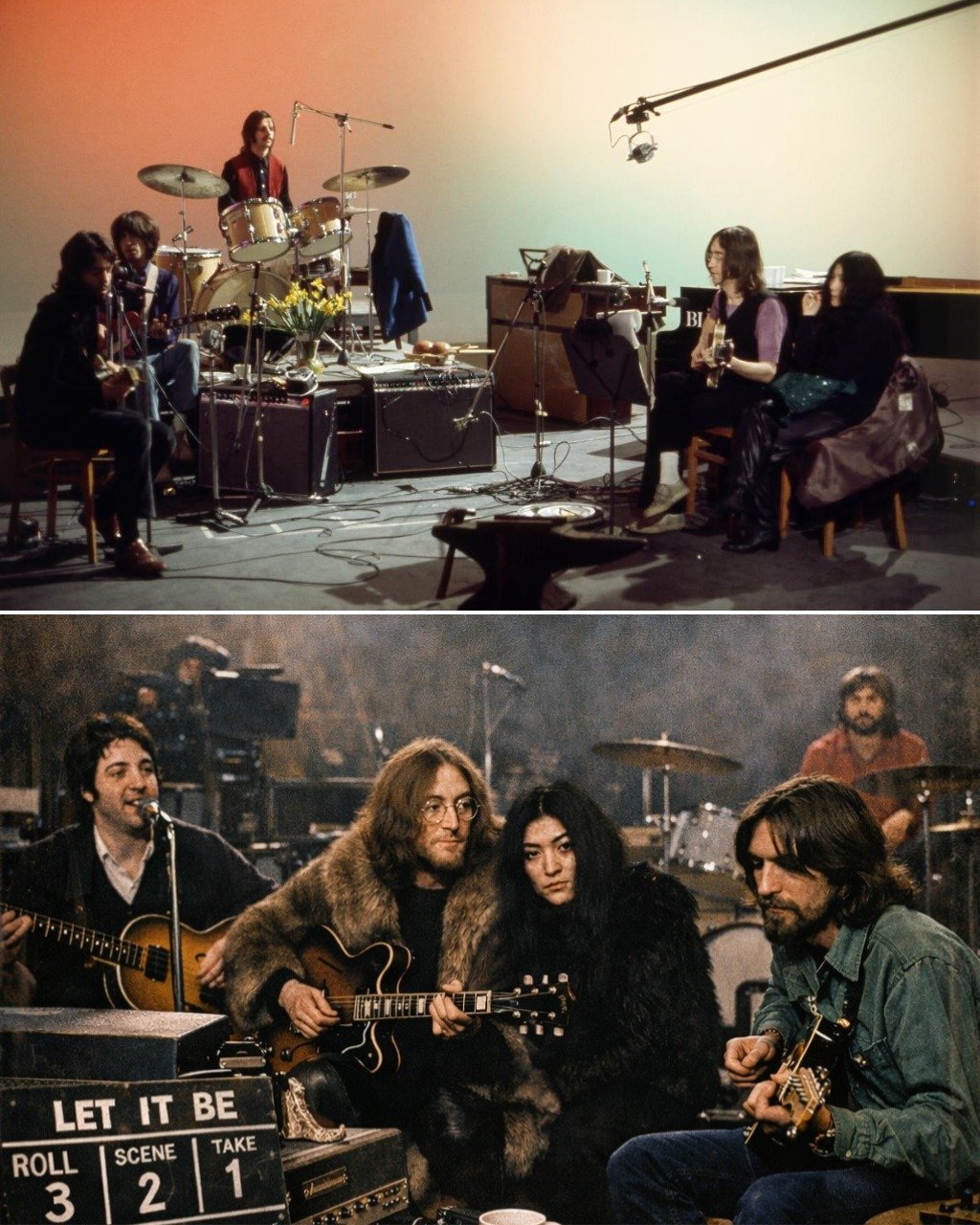
At 9:30 a.m. on January 2, 1969, inside Twickenham Film Studios, the end of The Beatles didn’t explode.
It didn’t arrive with shouting, slammed doors, or dramatic ultimatums.
It arrived quietly.
This was meant to be the beginning of something hopeful — a back-to-basics project, filmed rehearsals, a return to being a band again. The idea was simple: write new songs, rehearse them live, and end with a performance that would remind the world who they were.
Instead, that first unguarded hour revealed what none of them were ready to say out loud: the band was already gone.
A Cold Room and Colder Energy
Twickenham Studios in early January was not kind. The cavernous soundstage was poorly heated, the lights harsh, the atmosphere stiff. This was not Abbey Road — no familiar warmth, no controlled environment. Just space, cameras, and tension.
One Beatle arrived early. Uneasy. Watching the room fill slowly, sensing something was wrong before anyone spoke.
One barely arrived at all, detached, distracted, already living in another world beyond the band.
One sat quietly, arms folded, resentment simmering beneath forced politeness.
And one — according to people present — already had one foot out the door, emotionally and creatively.
No one announced it. But everyone felt it.
The Silence Between the Notes
They picked up instruments. Songs were attempted. Jokes were made — or at least, attempts at jokes. None landed.
This is the detail most people miss: it wasn’t conflict that broke them. It was the absence of connection.
The songs didn’t lift the room. The familiar spark didn’t ignite. Glances lingered a second too long, then drifted away. No one took charge, and no one wanted to follow.
For years, The Beatles had been a closed circuit — four minds finishing each other’s musical sentences. That morning, the circuit was broken. Each of them was already somewhere else creatively, spiritually, personally.
And they all knew it.
Cameras Without Context
What makes this moment so haunting is that the cameras were rolling — but not watching.
The footage later used in Let It Be shows tension, disagreements, awkward exchanges. But it doesn’t show the real fracture point.
Because the real damage happened before anything dramatic occurred.
It happened in the first hour — when no one was performing for the camera yet, when habits hadn’t kicked in, when the truth slipped through in silences and body language.
By the time arguments appeared on screen, the outcome was already sealed.
Not a Breakup — a Realisation
This wasn’t the day The Beatles broke up.
It was the day they realised they already had.
Each member had evolved in different directions. Different ambitions. Different definitions of fulfillment. The band that once thrived on shared momentum was now four individuals orbiting the same name.
That morning at Twickenham wasn’t about conflict — it was about clarity.
No one said, “This is over.”
They didn’t need to.
They felt it.
And sometimes, that quiet knowing is more final than any argument could ever be.