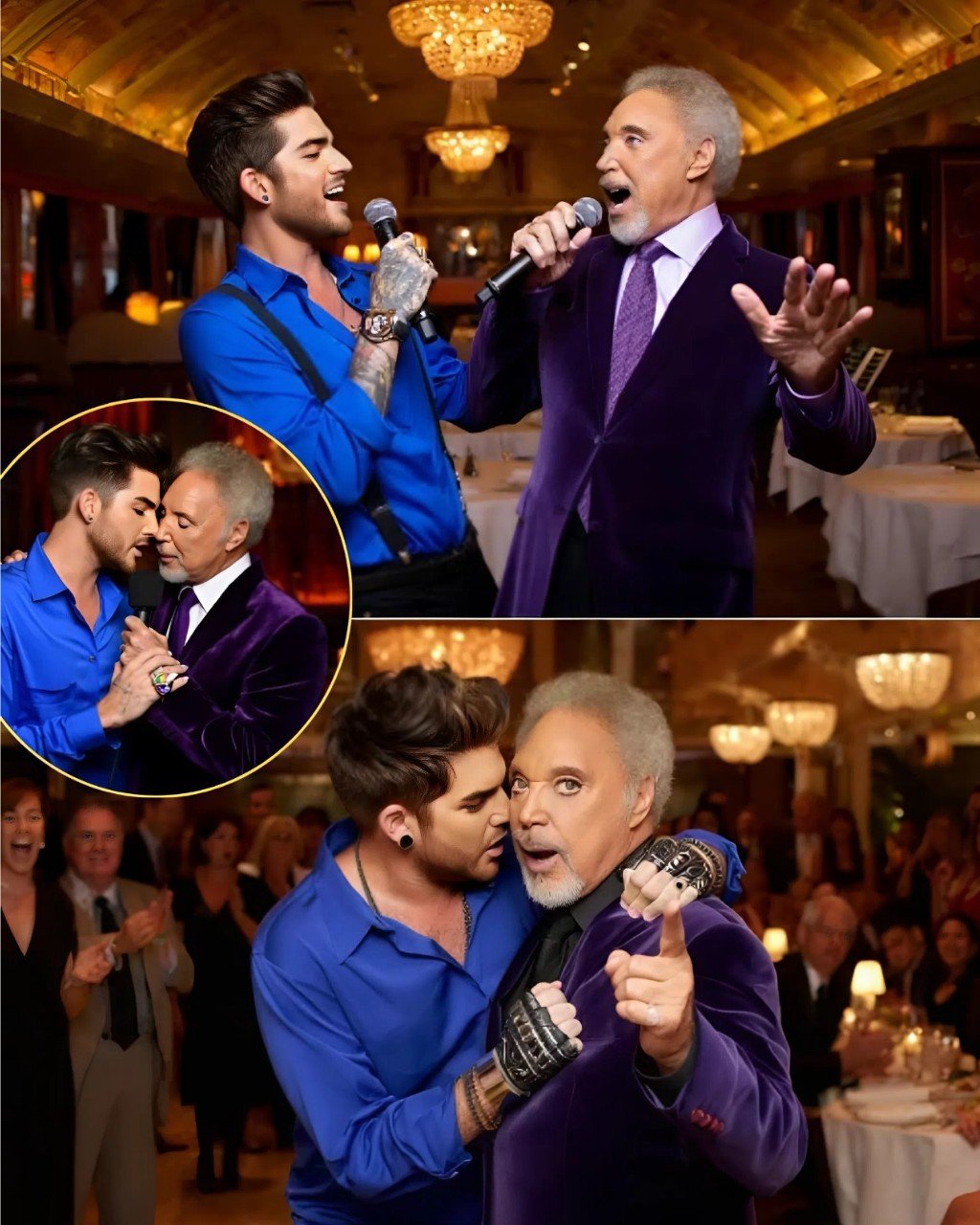
There was no stage. No introduction. No sense that anything remarkable was about to happen.
Just a candlelit corner, close enough to feel breath and body heat, where conversation slowly thinned into curiosity. Someone shifted. Someone laughed too loudly and then stopped. And in that quiet, Adam Lambert leaned forward — not like a performer claiming space, but like someone about to share a secret.
Then Sir Tom Jones answered him.
“Delilah” is a song everyone thinks they understand. Big chorus. Big drama. A classic worn smooth by decades of repetition. But in that moment, stripped of lights and distance, it changed shape entirely. It stopped being a song and became an exchange.
Their voices didn’t compete. They circled each other.
Adam didn’t oversing. Tom didn’t overpower. One line bent, the other caught it. A held note lingered just long enough to make the room lean in. A grin passed between them — not for show, but for recognition. Two artists listening as much as they were singing.
You could feel it happen when people stopped recording without realizing they had. Phones hovered mid-air, forgotten. Blinking felt risky. Even breathing sounded too loud.
The harmonies weren’t polished — they were alive. Flexible. Human. The kind that only exists when no one is chasing perfection and both trust the moment to carry them.
And when the final note faded, the applause didn’t arrive neatly.
It burst out.
Not polite. Not measured. A release — like everyone had been holding something in without knowing why. Because what they’d just witnessed wasn’t designed for arenas or broadcasts or algorithms.
Some performances aren’t meant to be replayed.
They’re meant for the people who happened to be there —
who walked into a room expecting nothing,
and left knowing they’d seen something that would never happen the same way again.