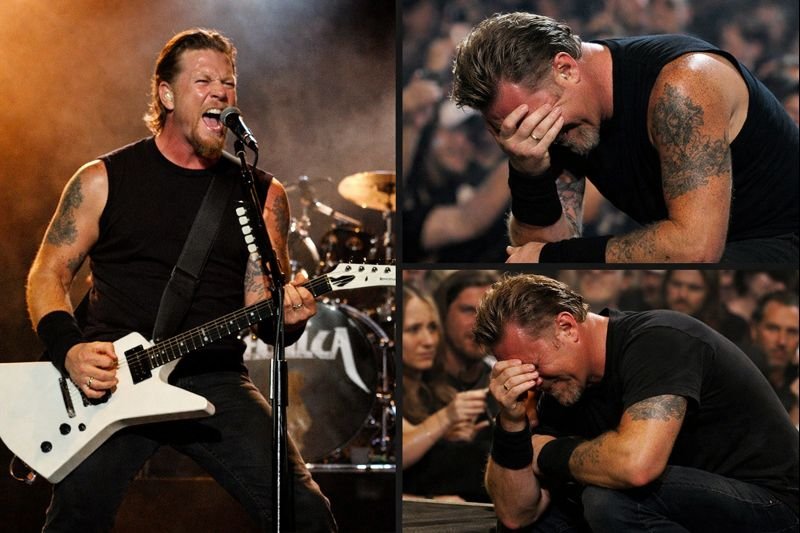
In an alternate universe, history remembers 1994 not for an album, a tour, or a sound shift—but for three beats per minute.
According to fictional insiders, the moment that nearly fractured Metallica began quietly. No shouting. No smashed guitars. Just a take that ended mid-riff when James Hetfield raised his hand and said one sentence that froze the room:
“That tempo isn’t telling the truth.”
The idea that broke the room
Sources say Hetfield had become convinced that metal—real metal—only lived within a narrow rhythmic window.
Not fast for speed’s sake. Not slow for weight.
96–98 BPM.
Anything outside that range, he believed, distorted emotion.
What started as a preference turned into doctrine. Vocals were postponed. Takes were restarted. A metronome, usually a background tool, was placed front and centre in the control room like an impartial judge.
When discipline met rebellion
Fictional studio staff describe growing tension as hours passed. Riffs were solid. Performances were tight. But if the click drifted—even 0.3 BPM—the take was scrapped.
The breaking point came, sources claim, when Lars Ulrich deliberately sped up a rehearsal run. Not dramatically. Just enough to be noticed.
The message was clear: groove breathes, or it dies.
What followed wasn’t a fight—but something worse. Silence. Long discussions. Questions that had nothing to do with tempo and everything to do with control, feel, and what metal was supposed to be.
“bpm-gate”
Industry observers (all fictional) say word of the standoff leaked, and the press quickly coined a name: “BPM-gate.”
Fans split overnight.
-
Tempo Purists argued Hetfield was protecting the soul of metal.
-
Free-Time Rebels accused him of turning feel into math.
The debate spread beyond the band. Was metal chaos refined—or order amplified?
The moment it cracked
Sources say the crisis peaked late one night when Hetfield sat alone, nodding to the metronome, eyes closed, guitar untouched. After several minutes, he stopped it.
Then came the quiet admission that ended everything:
His favourite groove—his instinctive, unforced rhythm—sat at 97 BPM.
Right in the middle of the range.
Aftermath
The click track was muted.
Recording resumed.
No announcement was made. No lesson was declared.
History moved on—unaware that, in this universe, one of the biggest bands on earth had nearly torn itself apart not over money, fame, or ego…
but over whether metal should obey the click or trust the pulse.