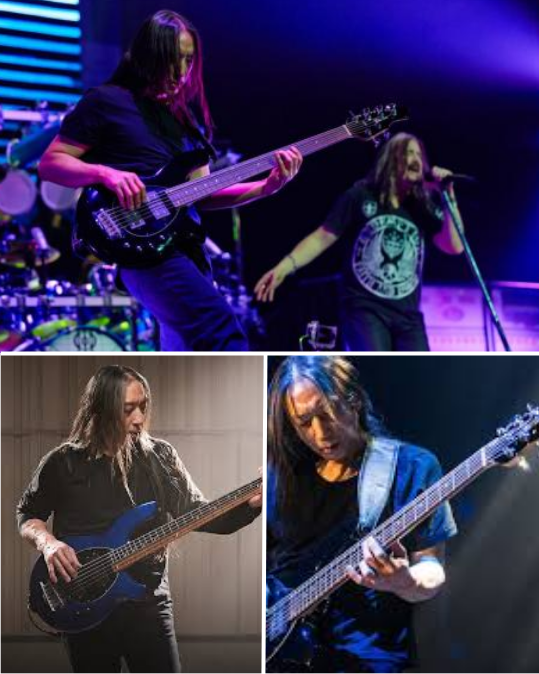
When people talk about progressive metal royalty, the conversation usually jumps to blazing guitar solos, impossible drum patterns, or soaring vocals. But behind the controlled chaos of Dream Theater’s legendary sound is a musician who has always operated with precision, discipline, and near-mythic calm:
John Myung — bassist, founding member, and one of the most technically respected players in modern rock and metal.
He’s not the loudest member of the band.
He doesn’t chase the spotlight.
But in many ways, Dream Theater doesn’t exist without him.
✅ Who Is John Myung?
John Myung is best known as the bassist and co-founder of Dream Theater, one of the most influential progressive metal bands in history. While many bassists stay locked into supporting roles, Myung helped shape a style where the bass is not just “background” — it’s a lead instrument, a rhythmic weapon, and a melodic engine all at once.
He’s widely admired for being:
-
Extremely technical
-
Clean and controlled
-
Emotionally expressive without being flashy
-
A master of complex time signatures
-
A composer with a deep musical mind
Even fans who aren’t bass players often say the same thing after watching him live:
“How is he doing that so effortlessly?”
🎓 Berklee and the Birth of Dream Theater
John Myung’s musical roots go deep. He studied at Berklee College of Music, where he crossed paths with fellow musicians who would eventually form Dream Theater.
This matters because Dream Theater wasn’t created like most bands — it wasn’t random garage jamming that turned into luck. It was built like a musical project with ambition, where technique and composition were part of the DNA from day one.
That education is a big reason why Myung’s playing sounds so deliberate. Even in the most chaotic sections of Dream Theater songs, he’s rarely “guessing.”
He’s calculating. Building. Driving the architecturez.
🎶 Myung’s Playing Style: Precision With Power
John Myung is often considered a bassist’s bassist — meaning musicians respect him not only for what he plays, but how he plays it.
🔥 1) Speed and Accuracy
Myung can play extremely fast passages with the accuracy of a machine — but it never feels random. His lines are composed with intention, and he locks in perfectly with the drums while still being melodic.
🎵 2) Melodic Basslines That Still Hold the Foundation
Many metal bassists vanish under heavy guitars. Myung doesn’t.
Even when buried in the mix on some recordings, his parts are doing critical work:
-
carrying harmony
-
creating counter-melodies
-
expanding the chord feel
-
anchoring rhythm changes
🧠 3) Advanced Rhythmic Control
Dream Theater is famous for:
-
odd time signatures
-
tempo changes
-
polyrhythms
-
sudden transitions
Myung thrives in that world. His bass often becomes the glue that holds the structure together when the song turns unpredictable.
🎧 4) Clean Tone and “Surgical” Technique
Myung is known for an articulate, clean tone that matches his playing personality. Even during complicated runs, his notes sound separated, clear, and intentional — not messy or blurred.
🏆 Why John Myung Is a Legend (Even Without the Hype)
Some artists build their legacy through personality. Myung built his through consistency and musical excellence.
He’s a rare type of musician:
world-class… without needing to announce it.
In a band full of big talents and bigger moments, Myung has stayed steady for decades. That’s a huge part of why Dream Theater’s sound has remained so tight across eras, albums, and lineup changes.
🎼 His Role as a Composer and Lyric Contributor
A lot of casual listeners assume Myung is “just the bassist.” That’s not accurate.
John Myung has contributed to Dream Theater’s creative direction over the years, including writing lyrics and helping shape the band’s deeper themes.
His writing often leans into:
-
introspection
-
philosophical ideas
-
identity and emotion
-
inner struggle and meaning
That fits his personality perfectly: thoughtful, grounded, and focused on substance.
🎸 John Myung’s Gear and Signature Sound
Myung has used different gear over his career, but fans often associate him with:
-
6-string basses (allowing him to cover lower lows and higher melodic range)
-
articulate, modern bass tone
-
tight, even dynamics
-
clean note separation
His gear choices support what he’s always done best:
clarity in complexity.
Because if your band writes songs that twist through time signatures and tempo shifts, your bass tone can’t be muddy — it has to speak clearly.
🎤 The Mystery of John Myung: Quiet, Focused, Unshakeable
One of the most fascinating things about Myung is his presence.
He’s famously reserved. He doesn’t chase attention in interviews, and for many years he was known as one of the quietest members of the band publicly.
But live on stage?
He’s locked in. Unshaken. Fully present.
That contrast adds to his legend:
the calm man holding the storm together.
He doesn’t need to say much — his playing speaks.
🎧 Essential Dream Theater Tracks Where Myung Shines
If someone wants to understand why John Myung is so respected, these types of Dream Theater moments are where you hear it:
✅ Bass-driven complexity
Songs where the bass is carrying movement, transitions, or rapid rhythmic patterns.
✅ Emotional melodic support
Ballads or mid-tempo tracks where the bass adds emotional weight without overplaying.
✅ Unison madness
Dream Theater is famous for unison runs between instruments, and Myung keeps up effortlessly.
Even if you’re not a technical listener, you can feel when his bassline is the backbone of the song.
🎵 Influence: Why Bass Players Study John Myung
John Myung is one of those musicians who has shaped a generation quietly.
Many modern players credit him for inspiring them to:
-
take bass seriously as a lead instrument
-
practice with discipline
-
learn theory and advanced technique
-
write bass parts that have identity
-
approach metal with musicality
He sits in the same category as players who pushed the bass beyond traditional roles — not through gimmicks, but through skill and vision.
⭐ Final Thoughts: The Backbone of a Giant
John Myung’s legacy is powerful because it’s built on mastery.
He helped create Dream Theater.
He survived every era of the band.
He stayed consistent through constant evolution.
And even in a group packed with virtuosos, he remains one of the most respected musicians in progressive metal history.
He’s proof that you don’t have to be the loudest person in the room to be essential.
Sometimes the real legend is the one holding everything together —
note by note, perfectly in time.