Charles’s Most Difficult Decision as King Arrives After a Lifetime of Public Scrutiny
Royal observers say the stripping of Andrew Mountbatten-Windsor’s remaining titles may be one of the hardest decisions King Charles has made during his reign. Yet, despite the intensifying scandal surrounding his younger brother, the King has remained composed and focused on duty.
Less than two weeks after formally removing Andrew’s use of the “prince” title, Charles – who turns 77 today – appeared poised and steady as he led the nation in a two-minute silence on Remembrance Sunday. It was a clear reminder of his commitment to public service and his ability to remain unflappable in moments of tension.
But long before he ascended the throne, Charles was far easier to unsettle. Royal author Ingrid Seward recounts that as a child, the future King was often made to feel different because of his position – and one moment in particular left him acutely embarrassed.
A Childhood Moment Charles Never Forgot
In Seward’s book My Mother and I, she describes how, during Charles’s school years at Cheam, the headmaster walked onto the stage in the middle of a performance of The Last Baron – an adaptation of Shakespeare’s Richard III, in which Charles played the lead – to announce that the Queen had given birth to Andrew.
According to the account, the unexpected timing and public nature of the announcement left the young Prince red-faced and self-conscious. Although excited about the birth of his brother, he reportedly felt singled out yet again because of his royal status.
This moment followed another earlier incident at Cheam. Charles, then nine years old, was in the headmaster’s study watching the closing ceremony of the 1958 Commonwealth Games. Suddenly, his mother’s voice came over the speakers announcing her intention to create him Prince of Wales. The room erupted into applause, and hundreds of Welsh voices sang “God Bless the Prince of Wales” – an overwhelming experience for a child not yet ten.
A Passion for Acting and a Growing Royal Profile
While at Cheam, Charles discovered a love for acting that later continued at Trinity College, Cambridge. He was praised in the school newspaper for his performance as Richard III after stepping into the leading role when another student left unexpectedly.
Yet even during this personal triumph, the spotlight of royal life followed him. On the final night of the play in February 1960, the headmaster delivered the announcement of Andrew’s birth. Seward notes that Charles’s embarrassment had little to do with the news itself, but rather the public attention it brought.
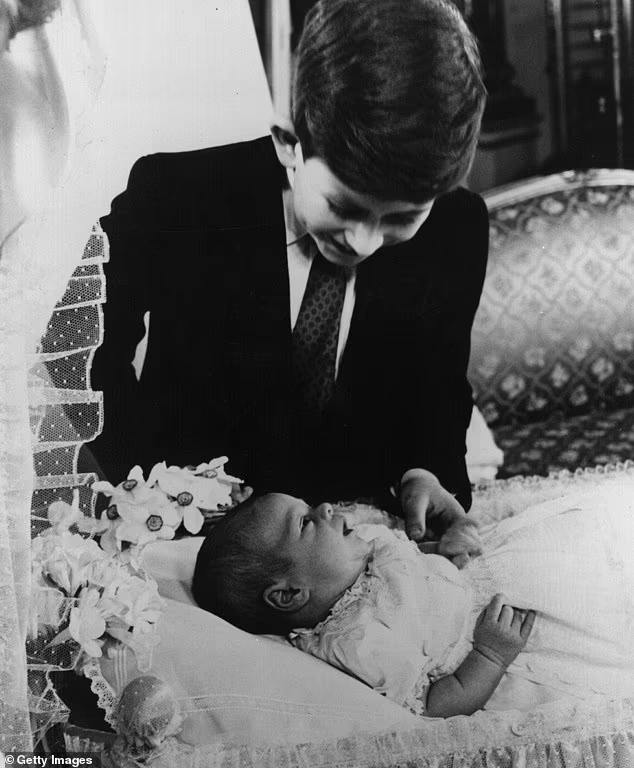
Still, the excitement of gaining a baby brother quickly took over. Back at Buckingham Palace, Charles spent much of his spare time in the nursery with Andrew and nanny Mabel Anderson. A touching photo released shortly after – taken by photographer Cecil Beaton – shows 11-year-old Charles gently holding his infant brother.
From Tender Brother to Resolute King
More than six decades later, Charles’s relationship with Andrew has shifted under the weight of recent controversies. According to The Times, the King ultimately decided to remove Andrew’s remaining titles after “significant welfare concerns” and ongoing internal discussions about the situation.
Sources told the outlet that the decision revealed a new side of Charles:
-
“We have seen his humanity, warmth and compassion,” said one senior figure.
-
“Now, we’ve seen his steel.”
Insiders also said that Andrew’s sense of identity had long been tied to status and that advisers questioned whether he would cope with further losses of position. Ultimately, however, the King was said to have reached a “tipping point.”
A Full Circle Moment
From a shy young boy embarrassed by a headmaster’s unexpected announcement to a monarch forced to deliver difficult news himself, Charles’s path has been defined by duty, sensitivity, and now, firmness.
What once left him blushing on a school stage has evolved into decisions that shape the future of the monarchy.