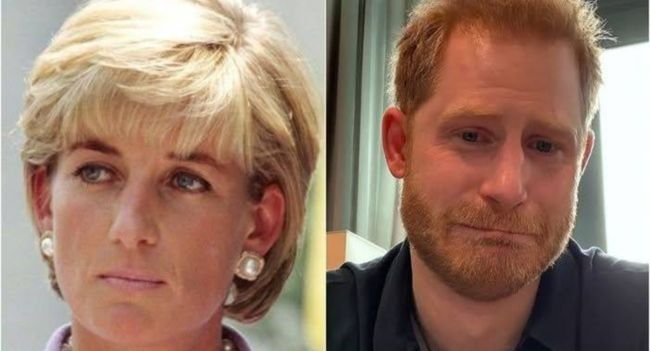
It was meant to be a routine television interview about his charitable work — yet what unfolded on live American television became one of Prince Harry’s most emotional and revealing moments to date.
During a broadcast dedicated to “wounds that never heal,” the Duke of Sussex broke down in tears while speaking about the loss that continues to define his life — the death of his mother, Princess Diana.
The studio fell completely silent. Cameras showed Harry’s shaking hands and tearful eyes as he tried to hold his composure. For a few minutes, the royal mask slipped away, and the world saw the boy who once walked behind his mother’s coffin before millions of mourners.
“I Still Wake Up Thinking It Was a Dream”
The conversation began calmly, as Harry spoke about mental health, veterans’ support, and his charity work with children affected by trauma. But when the topic turned to his mother, his voice broke.
“There are mornings I wake up and still think it was all a dream,” he admitted softly. “That she’s just… away for a while. And then I remember.”
When asked whether he had ever found peace with what happened that night in Paris in 1997, Harry paused for a long time before answering.
“Peace?” he repeated. “I’ve made peace with her memory. But not with the night itself.”
He explained that for many years, he couldn’t face the full truth of that tragedy — the flash of cameras, the tunnel, the silence that followed.
“I was twelve,” he said quietly. “Everyone told me to be strong. But how can a child make sense of losing his mother in front of the world?”
His Private Search for Answers
At one point, Harry revealed that as an adult, he quietly began searching for more clarity about what truly happened that night.
“I needed to know,” he said. “Not to accuse anyone, not to chase conspiracy theories — just to face the truth and stop running from it.”
He shared that he had revisited police reports, spoken to investigators, and even travelled privately to Paris years later.
“Standing in that tunnel was one of the hardest moments of my life,” he recalled. “It felt frozen — time, air, even my own breath. Like walking into a memory that never ended.”
That experience, he said, changed his outlook.
“I realised I’d been living with questions that didn’t need answers — only acceptance. I had to stop searching for blame and start searching for healing.”
“She Was My Compass”
When asked how he keeps his mother’s memory alive, Harry’s eyes filled with tears again.
“She was my compass,” he said. “Even when I lost my direction, I could still feel her guiding me — her laugh, her courage, her heart.”
He spoke about how he and Meghan share stories of Diana with their children.
“When Archie asks about Grandma Diana, we show him pictures and tell him how she changed lives by caring for people no one else cared about,” he said. “That’s what I want them to learn from her — to lead with kindness.”
The audience sat in silence, moved by his words.
“Grief Doesn’t Go Away — You Grow Around It”
Harry went on to describe grief not as something that ends, but as something that evolves.
“People think grief fades when the tears stop,” he said. “But really, it just changes shape. It becomes a part of you. You don’t move on — you move forward with it.”
He credited therapy, Meghan’s support, and his charitable projects with helping him heal.
“For years, I thought pain made me weak,” he admitted. “Now I understand — it teaches compassion. It makes you human.”
A Moment of Raw Emotion
By the end of the segment, Harry appeared emotionally drained yet peaceful. The host, visibly moved, thanked him for his honesty.
“You know,” he said with a faint smile, “my mum used to say, ‘When you speak truth, your heart starts to breathe again.’ I think tonight, mine finally did.”
The studio fell into a respectful silence — no applause, just quiet understanding.
Reactions Around the World
Within minutes, clips from the interview went viral. The hashtag #PrinceHarry trended across platforms, with thousands praising his openness and vulnerability.
Mental health advocates described the conversation as a turning point — “a powerful reminder that even those who seem strongest carry invisible wounds.”
Even long-time royal critics acknowledged the impact. “He didn’t speak as a prince,” one commentator noted. “He spoke as a son — and that’s why people listened.”
Healing Through Honesty
By morning, networks replayed the segment in full. Across the UK and beyond, people watched a prince who, after decades of silence, finally allowed himself to grieve publicly.
“She’s still with me,” Harry said in his closing words. “Not in the past, but in everything good I try to do. Every smile, every bit of kindness — that’s her living through us.”
The camera lingered on his tear-streaked face — the faint smile, the exhaustion, the peace.
And for the first time in years, Prince Harry seemed to stop running from the past — not as a royal, not as a public figure, but as a son finally ready to heal.