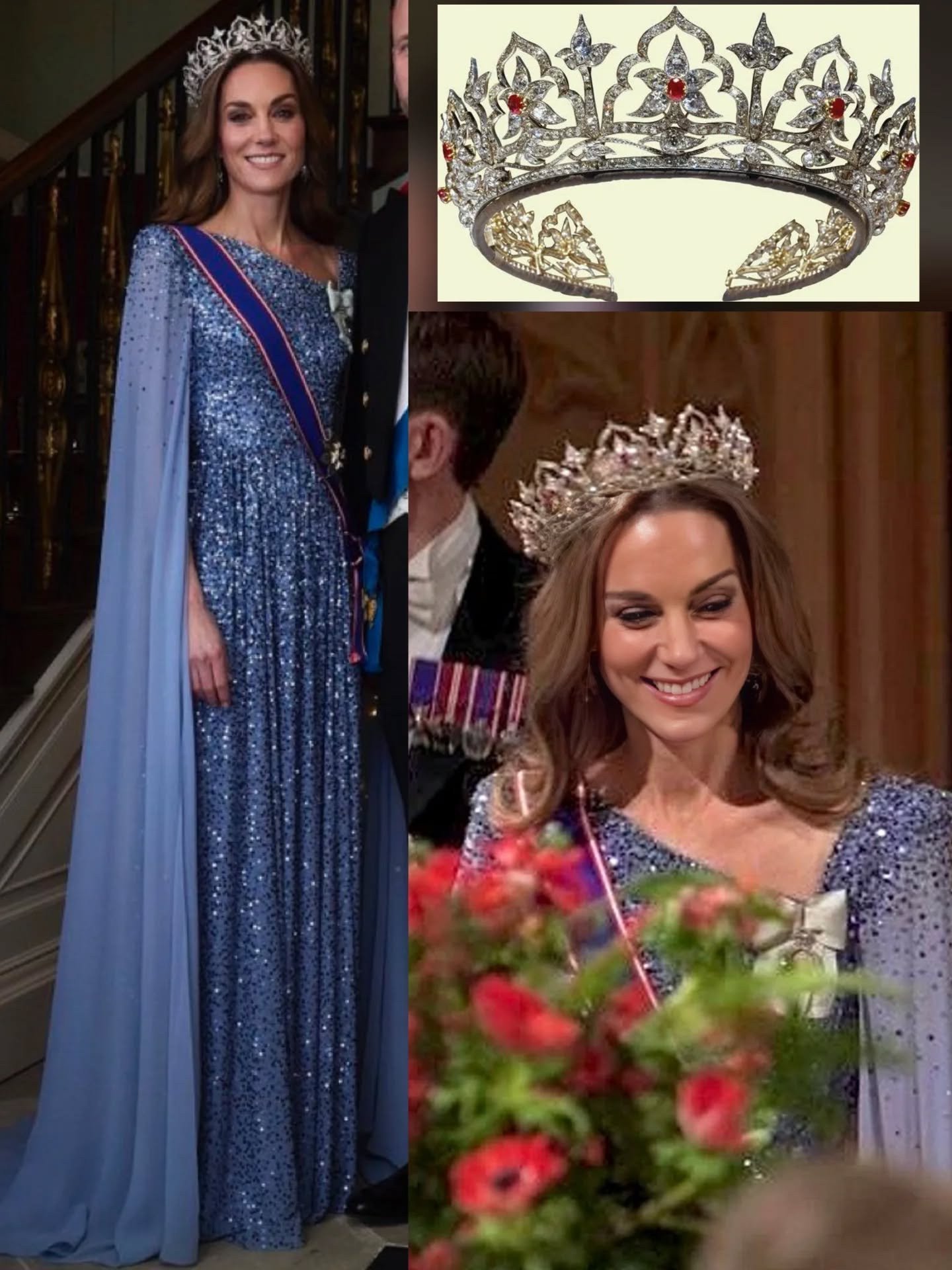
From Queen Victoria’s Widower’s Gift to the Dazzling Debut of the Princess of Wales, This Tiara Tells the Story of Three Reigns
LONDON — Among the most historically significant jewels within the British Royal Collection, the Oriental Circlet Tiara stands out not only for its striking beauty but for the deeply personal, and sometimes superstitious, drama embedded in its creation and transformation. Recently brought back into the spotlight by the Princess of Wales, its long journey spans three centuries, surviving mourning, superstition, and the passage of power.
The Oriental Circlet is one of the oldest pieces created for the Royal Family by the esteemed House of Garrard, a jeweller synonymous with royal heritage. Its life began not as the magnificent ruby piece we see today, but as a tender expression of love and fascination with the exotic East.
I. The Vision of Prince Albert and the Power of Opals
The circlet was commissioned for Queen Victoria in 1853, crafted under the meticulous direction of her beloved husband, Prince Albert. The period was marked by a romantic fascination with India, which the British Empire was rapidly expanding its influence over, and Albert, with his eye for design and detail, sought to capture this aesthetic.
The resulting design is one of high Victorian grandeur, featuring 17 majestic ‘Mughal’ or Indian-inspired arch motifs, each framing a central jewel. The entire structure is set with a spectacular array of 2,600 diamonds.
Crucially, when the piece was first created, those central arches housed a collection of vibrant opals. Opals were, at the time, one of Prince Albert’s favourite gemstones, known for their shimmering, multi-coloured play-of-light. The tiara, therefore, was not merely a jewel, but a highly personal gift reflecting the aesthetic preferences of the Consort who was so influential in shaping Victoria’s collection.
II. Mourning, Alterations, and the Shadow of Loss
Despite the perfect collaboration between the Queen, the Prince, and Garrard, the tiara’s early years were overshadowed by tragedy. In 1858, the circlet was briefly returned to Garrard for minor alterations. It had barely been returned to the Queen when Prince Albert fell ill and unexpectedly died, aged just 42.
The loss devastated Queen Victoria. Her profound grief marked a monumental shift in her life, her court, and even her jewellery. For the rest of her life, she famously mourned Albert by wearing black and replacing almost all of her vivid, coloured gems with solemn mourning jewellery—pieces incorporating black jet, onyx, or simply colourless diamonds.
Consequently, after 1861, the vibrant Oriental Circlet with its light-dancing opals was consigned to the vaults, rarely, if ever, seen in public by the grieving monarch.
III. The Transformation: Superstition and the Burmese Rubies
The tiara finally re-emerged from the shadow of mourning in 1901, when it was inherited by Victoria’s daughter-in-law, Queen Alexandra.
Alexandra, however, harboured a strong personal superstition surrounding opals. In the late 19th and early 20th centuries, a belief had taken hold, partly popularized by Sir Walter Scott’s novel Anne of Geierstein, that opals were unlucky—a belief many jewellers and wearers still struggled with.
Queen Alexandra quickly returned the circlet to Garrard with a very specific, and highly fortunate, request: she asked that the opals be replaced. The substitute stones were a collection of magnificent, deep-red Burmese rubies which had been given to Queen Victoria as a gift from the ruler of Nepal. The intense colour and fire of the rubies added a new dimension of grandeur and drama to the tiara, creating the now-famous ruby and diamond configuration. The Indian-inspired design of lotus flowers and Mughal arches remained largely the same, but the jewel was visually reborn.
IV. The QueenMother’s Favourite and the Silent Years
Following Queen Alexandra, the tiara passed down through the generations, finding its next long-term custodian in Queen Elizabeth, The Queen Mother, in 1936.
The Queen Mother possessed a vast and enviable collection of jewels, but the Oriental Circlet quickly became one of her favourites. She was photographed wearing it on numerous high-profile occasions throughout her long life, often pairing it with her voluminous, curled hairstyles. She gave the circlet a renewed sense of glamour and visibility, cementing its place as a jewel of national importance.
Following the death of her husband, King George VI, in 1952, the Oriental Circlet should technically have passed to the newly ascended monarch, Queen Elizabeth II, under the terms of the inheritance. However, realizing how much her mother loved the piece and how often she wore it, Queen Elizabeth II made the generous decision to allow her mother to keep it. This act of filial devotion kept the tiara firmly in the Queen Mother’s possession until her death fifty years later.