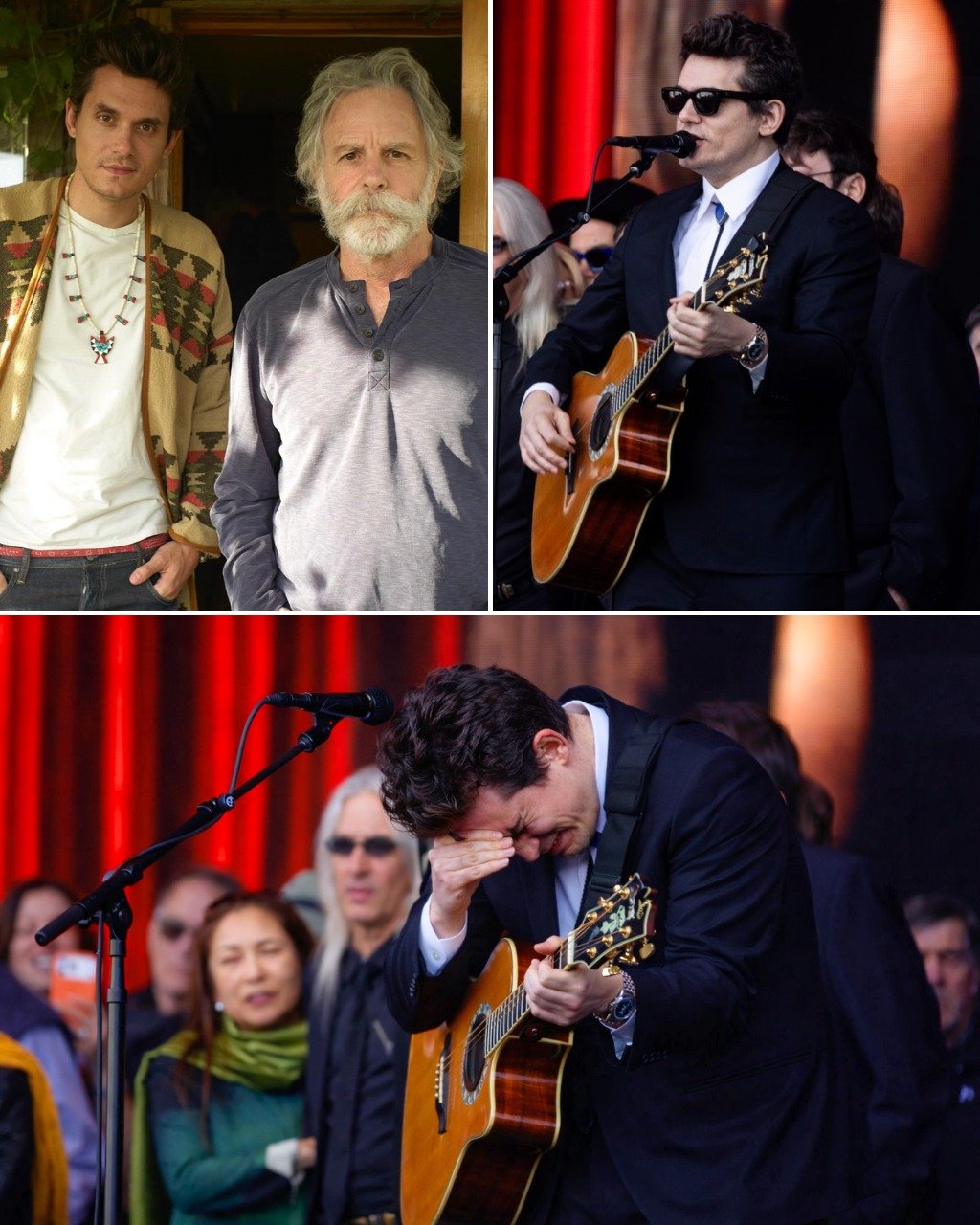
In an imagined moment that feels as real as the music itself, San Francisco gathers—not in mourning, but in reverence. The city hums with that familiar Grateful Dead energy: generations overlapping, stories crossing, strangers connected by a common rhythm. At the heart of it all stands Bob Weir’s legacy—alive, enduring, and impossibly vast.
Then John Mayer steps forward.
The crowd quiets, not because it’s asked to, but because it senses something meaningful is about to unfold.
A Stage That Felt Like Sacred Ground
In this fictional retelling, Civic Center Plaza becomes less of a venue and more of a communal space—one shaped by decades of shared songs and open-ended journeys. Mayer, long associated with Weir through their time in Dead & Company, doesn’t approach the moment as a headliner. He arrives as a student, a collaborator, and a caretaker of something much larger than himself.
Before a single note is played, he speaks—not rehearsed words, but reflections. He talks about trust. About being handed a songbook that carried entire worlds inside it. About learning that these songs were never just melodies, but invitations.
More Than Music
In this imagined scene, Mayer recalls how Weir didn’t simply teach him how to play the music—he taught him what it meant. How each song held space for interpretation, community, and freedom. How the Grateful Dead ethos was less about perfection and more about presence.
He speaks of being welcomed into a lineage that didn’t demand imitation, only honesty.
For the crowd, these words land heavily. Many have lived their lives inside these songs. Others are just discovering them. In that moment, the distance between fan and performer disappears.
The Song That Changed the Air
When Mayer begins to play Ripple, the city seems to lean in. Traffic noise fades. Conversations stop. Even the wind feels still. The song isn’t rushed or dramatized—it’s offered gently, as if it belongs to everyone listening.
In this fictional tribute, the performance becomes a shared breath. Some close their eyes. Some hold hands. Some quietly sing along, barely louder than the guitar.
It’s not about loss. It’s about continuity.
A Community Remembering Itself
What makes the moment linger isn’t technical brilliance—it’s recognition. Recognition that these songs outgrew their creators long ago, becoming vessels for memory, comfort, and connection. Mayer doesn’t try to claim them. He simply carries them forward for a few minutes, then sets them back down where they belong.
In this imagined night, the applause is delayed—not out of uncertainty, but out of respect. No one wants to break the spell too quickly.
Why the Moment Matters
This story resonates because it reflects something true, even if the scene itself is imagined: Bob Weir’s influence isn’t confined to a band, an era, or a stage. It lives in the musicians he inspired, the fans he gathered, and the communities that continue to form wherever the music plays.
And John Mayer’s role in that universe isn’t about replacement—it’s about stewardship.
When the song ends and the city exhales, one thing is clear: some performances don’t aim to impress. They aim to honor.
And those are the moments that stay with us long after the last note fades.