From Queen Victoria’s Rubies to Queen Elizabeth II’s Diamonds, the Working Royals Deliver a Dazzling Display of History and Heritage
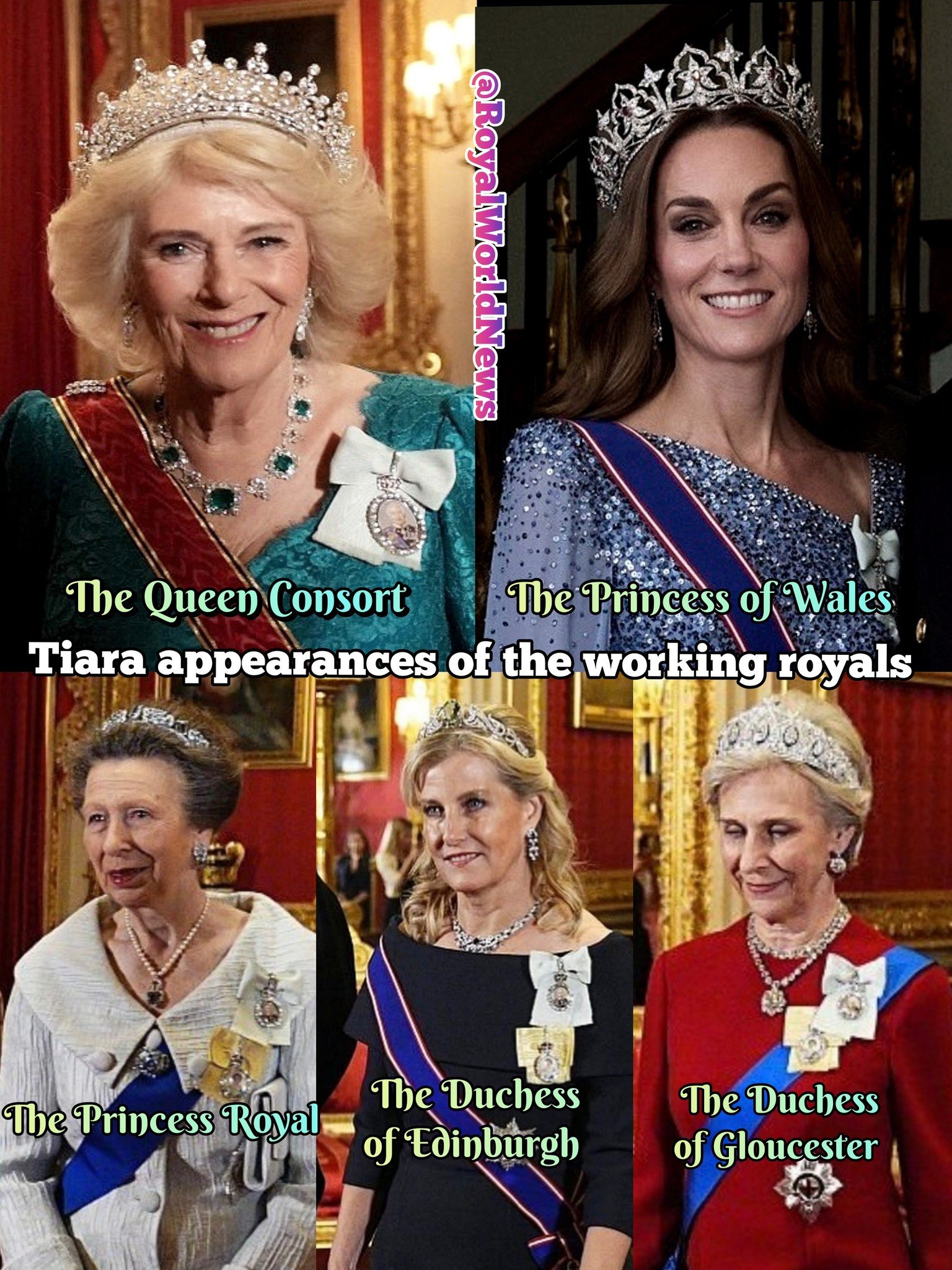
WINDSOR CASTLE, UK — The recent German State Banquet, hosted by King Charles III and Queen Camilla in honour of President Frank-Walter Steinmeier and First Lady Elke Büdenbender, was more than a formal diplomatic engagement; it was a spectacular showcase of the Crown’s most storied jewels. The gathering of the British Royal Family’s female working members—each adorned in a magnificent tiara—transformed the evening into a powerful, glittering assertion of continuity, history, and the deep, complex ties between the two nations.
The selection of headpieces was highly curated, with each jewel carrying a profound historical or personal significance. The coordinated display served as a visual history lesson, linking the modern monarchy directly back to Queen Victoria and her German-born consort, Prince Albert, whose influence was palpable throughout the evening.
I. The Queen Consort and the Symbol of Continuity
Leading the dazzling procession was Queen Camilla, who chose the most significant tiara in recent memory: Queen Elizabeth II’s Girls of Great Britain Diamond Tiara.
This choice was a clear and powerful symbol of continuity and respect for the late monarch. Often simply referred to as “Granny’s Tiara” due to its association with Queen Elizabeth II, this piece was arguably the late Queen’s most cherished and most frequently worn tiara throughout her 70-year reign.
A History of Trust: Originally a wedding gift to the future Queen Mary in 1893 from “The Girls of Great Britain and Ireland,” the tiara was later bequeathed to Queen Elizabeth II. Its structure is instantly recognizable: a delicate, diamond-set bandeau topped by large, brilliant-cut diamonds and historically featuring a detachable base that could be worn as a necklace. By selecting this iconic piece, Queen Camilla not only honoured her mother-in-law’s memory but also visually cemented her role as the new Queen Consort, embracing the mantle and the heritage of the previous era. Her decision speaks volumes about her desire to maintain the stability and tradition of the Crown.

II. The Princess of Wales and the Oriental Masterpiece
Catherine, the Princess of Wales, made a stunning, highly anticipated debut in Queen Victoria’s Oriental Circlet Tiara. This choice immediately cemented the tiara as a central piece for the Carolean era and served as a profound diplomatic gesture tailored specifically for the German delegation.
The history of the tiara is intricately linked to Germany: it was designed in 1853 by Prince Albert, the German-born Consort, for his wife, Queen Victoria.
A European Design: Inspired by the Eastern jewelry seen at the Great Exhibition, the original circlet featured seventeen ‘Mughal’ arches and around 2,600 diamonds, initially set with opals. However, the subsequent replacement of the opals with vibrant rubies by Queen Alexandra created the stunning, ruby-accented piece Catherine wore—a masterful blend of Eastern design and Western craftsmanship.
By choosing Albert’s creation, Catherine subtly acknowledged the deep German roots interwoven with the British Royal Family’s history, showcasing the highest level of respect and pomp afforded to their European partners. This debut asserts Catherine’s role as a confident, central figure and a graceful custodian of the Crown’s most dazzling and diplomatically sensitive treasures.
III. The Aquamarine Gems: Anne and Sophie
The presence of the Princess Royal (Anne) and the Duchess of Edinburgh (Sophie) added a splash of cool, icy colour to the diamond-heavy spectacle, as both chose magnificent aquamarine tiaras. Aquamarines, often symbolizing hope, clarity, and well-being, were a refined choice for a State occasion focused on strengthening international ties.
The Princess Royal’s Aquamarine Pineflower Tiara
Princess Anne wore the striking Aquamarine Pineflower Tiara, a piece deeply associated with her. This tiara, known for its strong, slightly modern geometric structure featuring aquamarines and diamonds, was a gift to Queen Elizabeth The Queen Mother in 1947. Anne has made this tiara her own, frequently wearing it on State occasions where its distinct, clean lines perfectly complement her formal style.
The Duchess of Edinburgh’s Convertible Tiara
Sophie, the Duchess of Edinburgh, opted for the elegant Aquamarine Necklace Tiara. The Duchess has favored this piece, which is particularly notable for its versatility: it can be converted and worn as a magnificent necklace. The Aquamarine tiara, which features a central cushion-cut aquamarine surrounded by a symmetrical scroll of diamonds, provides a softer, more delicate silhouette compared to the heavy Victorian pieces. This choice underscores Sophie’s modern, accessible approach to royal dressing while still honouring the grandeur of the event.
IV. The Duchess of Gloucester and the Cartier Indian Tiara
Perhaps the tiara with the most direct, yet complicated, link to the Anglo-German royal history worn that night was the Cartier Indian Tiara, worn by Birgitte, the Duchess of Gloucester.
This tiara’s story is a fascinating weave of international aristocracy and inheritance. It was originally made in 1923 by Cartier for Beatrice Forbes, Countess of Granard. However, its royal chapter began in 1937 when it was bought from Cartier by Princess Marie Louise of Schleswig-Holstein specifically to be worn to the Coronation of King George VI.
The German Inheritance: Princess Marie Louise was a granddaughter of Queen Victoria and the daughter of Princess Helena, who married a German prince, Prince Christian of Schleswig-Holstein. Crucially, Marie Louise herself married a German prince, Aribert of Anhalt, in 1891 (a marriage that was annulled, reportedly without being consummated). When Princess Marie Louise passed away in 1956, she bequeathed the tiara to her godson, Prince Richard, who became the Duke of Gloucester—Birgitte’s husband.
Thus, the Duchess of Gloucester’s choice served as a profound, tangible link to Queen Victoria’s lineage through a family inheritance route—a perfect, if subtle, nod to the German connection at the heart of the State Banquet. It represents the quiet, enduring ties between the houses of Hanover, Schleswig-Holstein, and the British Royal Family.
Conclusion: A Dazzling Declaration of Unity
The array of tiaras worn by the working royal women at the German State Banquet—from Camilla’s symbol of continuity to Catherine’s diplomatic masterstroke, the Aquamarine beauty of Anne and Sophie, and the storied inheritance of Birgitte’s Cartier piece—was a potent declaration.
Each jewel was carefully selected to convey a message of unity, respect, and the profound depth of the monarchy’s historical roots. The evening transcended mere pomp; it was a demonstration that in the world of international diplomacy, history is not just read in books—it is worn on the head, dazzling under the crystal chandeliers of Windsor Castle. The sheer power of this collective display reaffirmed the British monarchy’s unique ability to utilize its heritage as a powerful tool for diplomacy and connection in the modern age.