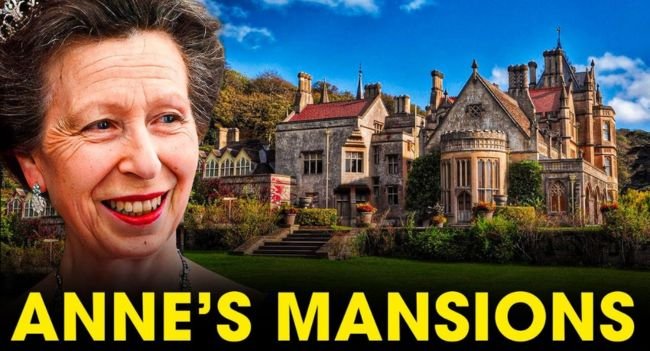
Few members of the royal family embody the essence of old money quite like Princess Anne. Practical, private, and profoundly hardworking, the Princess Royal has long been admired for her unpretentious dedication to duty — and her equally understated taste in royal living.
Yet behind the gates of her countryside estates lies a world of quiet grandeur: sweeping landscapes, ancestral architecture, and interiors that whisper of centuries past. With new insights emerging about the properties Queen Elizabeth II personally ensured would remain in Anne’s care, royal-watchers are now gaining a rare glimpse into the hidden beauty of the Princess’s cherished homes.
From Gatcombe Park’s pastoral perfection to her Scottish refuge at Craigowan Lodge, these estates are more than royal real estate — they are living reflections of character, heritage, and the enduring spirit of the woman often described as the monarchy’s backbone.
Gatcombe Park: The Beating Heart of Country Royalty
Tucked within the Gloucestershire countryside, Gatcombe Park is more than a residence — it is a working estate. Gifted to Princess Anne by Queen Elizabeth II in the 1970s, the Georgian manor was once described by the late monarch as “a true English paradise.”
Surrounded by more than 700 acres of rolling farmland, Gatcombe embodies both grandeur and groundedness — much like its owner. The honey-coloured Cotswold stone façade dates back to the 18th century, and inside, panelled drawing rooms display ancestral portraits in gilded frames while sunlight spills through sash windows onto Persian rugs and antique walnut desks.
But unlike the gilded opulence of Buckingham Palace or Windsor Castle, Gatcombe exudes warmth and familiarity. Dogs roam freely, boots line the hallways, and the faint scent of hay drifts in from the stables.
“It’s a home, not a palace,” one visitor remarked. “Everything feels quietly worn — polished by time, not design.”
The estate also hosts the annual Festival of British Eventing, a renowned equestrian celebration presided over by Princess Anne herself. The fields transform into arenas where horses, riders, and royals mingle in a display of skill, tradition, and camaraderie.
It’s here that Anne’s children, Peter Phillips and Zara Tindall, grew up galloping across meadows — and where her grandchildren now play, often under the watchful eye of “Granny Anne.”
Craigowan Lodge: Scotland’s Hidden Gem
While Balmoral Castle remains the crown jewel of the royal family’s Scottish holdings, Craigowan Lodge — a short drive from Balmoral — has always been Princess Anne’s personal Highland haven.
Nestled among birch trees and wild heather, the seven-bedroom stone lodge represents simplicity at its most regal. Unlike Balmoral’s stately halls, Craigowan feels intimate — a place where fireplaces never go out and tartan blankets are always close at hand.
It is said that the late Queen left Craigowan Lodge specifically to Anne in her private will, ensuring her most grounded child would have her own Scottish retreat. “It was her sanctuary,” recalled one Balmoral staff member. “Her Majesty knew Anne loved the Highlands as much as she did — the solitude, the horses, the weather, even the midges.”
Inside, the décor pays homage to Scotland: dark wood panelling, family tartans, and shelves filled with worn riding manuals and history books. The walls display sketches of royal corgis and foxhounds, while the kitchen remains charmingly unpretentious — stocked with enamel mugs, homemade jam, and endless tea.
“Anne doesn’t live like a royal cliché,” an aide noted. “She lives like a countrywoman with impeccable manners.”
St. James’s Palace Apartment: The Quiet London Base
Amid London’s historic bustle, Princess Anne maintains a discreet residence at St. James’s Palace — the Tudor fortress that has housed royals since the 1500s.
Her apartment, rarely photographed, is said to balance historic charm with practicality. High ceilings and damask drapes pair with modern furnishings and efficient layouts.
“Anne’s London quarters are modest by royal standards,” says historian Charlotte Avery. “She keeps only what she needs for work — uniforms, papers, and memories. For her, London is for duty; the countryside is for life.”
A Legacy of Modesty and Strength
When Queen Elizabeth II drafted her private provisions, few were surprised that Princess Anne was among her most trusted heirs. What did surprise many was how deliberately the Queen ensured her daughter’s lasting connection to Britain’s heartlands.
“Her Majesty knew Anne’s heart was always in the country,” says royal biographer Daniel Havers. “She wanted her daughter to inherit not just property, but peace.”
The inheritance reportedly includes historic equestrian acreage, vintage carriages, and personal keepsakes tied to the Queen’s own early riding days — heirlooms passed from mother to daughter, queen to princess.
Those close to Anne say she was deeply moved when told of her mother’s final gesture. “She simply said, ‘Mummy always knew what mattered most,’” shared a family friend.
Old Money, Modern Spirit
In an age of social media and spectacle, Princess Anne’s quiet estates redefine what “old money” truly means — enduring, discreet, and rooted in legacy rather than luxury.
There are no golden chandeliers or curated drawing rooms here — only weathered stone, creaking staircases, and the laughter of family across centuries-old fields.
The Princess still rises early, tends her horses herself, and often drives her own car to engagements. “It’s not for show,” a palace staffer explained. “That’s just who she is — she works, she rides, she reads, and she rests, surrounded by her mother’s memory.”
A Royal Philosophy Set in Stone
Every wall of Gatcombe and Craigowan echoes the bond between mother and daughter — two women defined by duty, simplicity, and steel. Where others see luxury, Anne sees responsibility. Where others inherit titles, she inherits work.
“These homes aren’t trophies,” one friend reflected. “They’re trusts — places to preserve, protect, and quietly live.”
And perhaps that’s why Queen Elizabeth chose her daughter as guardian of these royal treasures. In a world obsessed with glamour, Princess Anne remains proof that true wealth doesn’t glitter — it endures.
Behind ivy-covered walls and the scent of pine, the Princess Royal continues her quiet reign: caring for horses, hosting charity events, writing thank-you notes — all under the timeless roofs of homes that carry both her name and her mother’s grace.
For the woman who never sought grandeur, these “old money” estates stand as living proof that heritage, humility, and hard work never go out of style.