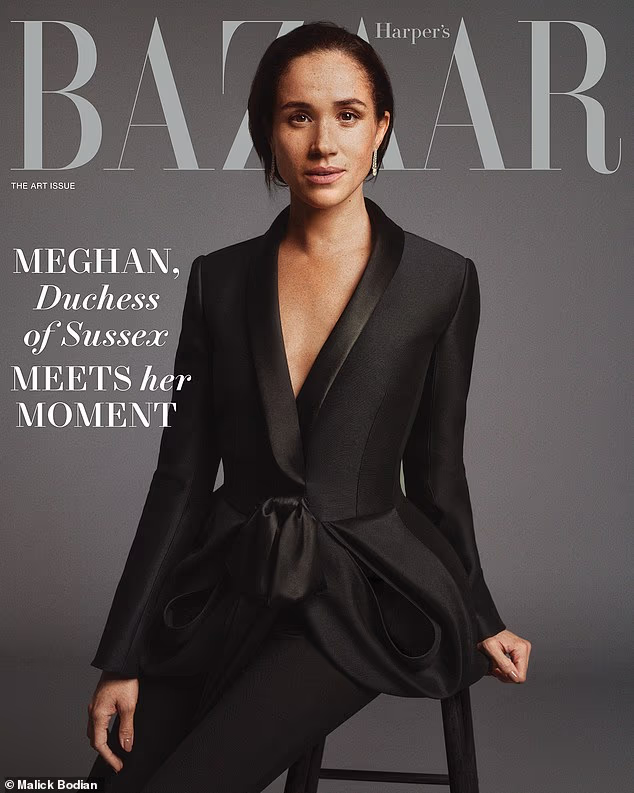
In her new Harper’s Bazaar feature, Meghan Markle talks extensively about living a life that “feels authentic,” rejecting perfection, and distancing herself from “external judgement.” Writer Kaitlyn Greenidge portrays her as a woman seeking a sharper sense of self — someone eager to show her face, her thoughts, and her brand without filters.
Meghan’s pared-back look, however, has revived claims that she is following the path Pamela Anderson set when she embraced a no-makeup aesthetic. The minimalist black-and-white cover that was meant to signal vulnerability and artistic simplicity quickly triggered comparisons to Anderson across social media.
“Is this supposed to be like the Pamela Anderson no-makeup moment?” one X user asked. “This is not going to go well for Meghan.”
It has now been over two years since Anderson famously attended Paris Fashion Week makeup-free, a moment that prompted Jamie Lee Curtis to declare, “the natural beauty revolution has officially begun.” Pamela’s soft hair, untouched freckles, and bare-faced confidence were widely praised as refreshing and bold.
The comparisons first surfaced again in March when Meghan released the official trailer for her Netflix cooking show With Love. Some viewers immediately pointed out that the teaser looked strikingly similar to Pamela Anderson’s Cooking With Love, which debuted just six months earlier. Nearly identical garden-walking shots, similar outfits, airy kitchens, and even closely matched titles led critics to accuse Meghan of copying. Though Pamela brushed off the chatter and some fans believed the similarities were coincidental, the discussion never fully disappeared.
Now, with Meghan’s latest cover, the comparisons have reignited.
The Duchess maintains that her new philosophy centres on simplicity. “The moment you start making decisions based on external judgement, you lose your authenticity,” she says. But many noticed that her words echoed sentiments Pamela Anderson expressed earlier about “self-acceptance” and the relief of no longer “playing characters” in real life.
Supporters insist that embracing a natural look doesn’t amount to imitation. Critics argue the opposite — that Meghan’s minimal aesthetic feels carefully crafted rather than spontaneous, particularly when paired with a tailored Dior suit, dramatic lighting, and a symbolic studio pose.
“It’s giving Pamela Anderson era,” one commenter wrote. “But not in a good way.”
Another added: “She was aiming for vulnerability — but it feels like she’s trying to be someone else.”
Meghan’s return to a stripped-down style for her first magazine cover in seven years has led many to question whether it’s another subtle nod to Pamela. Some traced the similarities even further back to Meghan’s own appearance at Paris Fashion Week earlier this year, where her barely-there makeup strongly resembled Pamela’s now-iconic 2023 look.
Adding to the conversation, Meghan’s longtime makeup artist Daniel Martin — who created her wedding look — confirmed that she wasn’t actually makeup-free in Paris. The intention, he said, was simply to appear “light, fresh, radiant.”
That same glow resurfaced in April during Meghan’s emotional appearance on Jamie Kern Lima’s podcast, where she cried reading a message from her children and reflected on the comfort of going without makeup: “This is why it’s so nice to have no makeup on.”
Whether intentional or not, the pattern has convinced many that Meghan is entering a full “Pamela phase.”
But the Harper’s Bazaar profile extends well beyond aesthetics. Meghan speaks about her marriage, saying, “No one in the world loves me more than him,” and describing Harry as someone who brings “childlike wonder and playfulness” into their home. Greenidge notes a curious detail too: Meghan is formally announced as “Meghan, Duchess of Sussex” even when she is the only person in the house — something some readers find theatrical and others see as a sign of how deeply she still identifies with her royal status.
Meghan also discusses motherhood, her lifestyle brand As Ever, and the values she hopes to instil in her children. “There’s no such thing as perfect,” she says. “I get to make mistakes too.”
Yet critics argue that imperfection is precisely what Markle struggles to project. They believe her “authenticity” remains tightly curated, and that borrowing the visual language of a cultural icon like Pamela Anderson may be a deliberate attempt to reinvent herself after years of criticism.
To admirers, Meghan’s bare-faced presentation feels like honesty. To sceptics, it looks like strategy. And to many observers, the similarities to Pamela Anderson’s pioneering moment are simply too pronounced to overlook.
Whether coincidence or calculated rebranding, Meghan’s latest public shift has sparked another round of debate — about image, influence, and the thin line between homage and imitation.