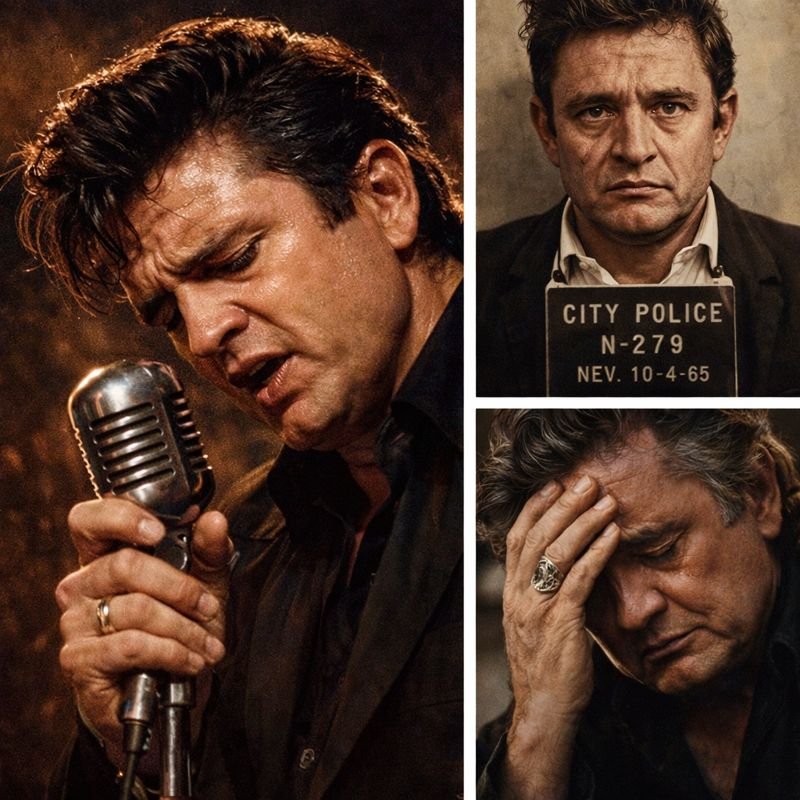
To millions of Americans, Johnny Cash is more than a musician. He is a symbol – the Man in Black, the voice of prisoners, the conscience of country music, and a moral figure who stood with the forgotten.
But the legend was not built on purity.
It was built on contradiction.
Behind the myth sits a long record of real scandals and public battles, documented in court files, biographies, interviews, and Cash’s own brutally honest confessions.
Johnny Cash didn’t just sing about darkness.
He lived inside it.
A public collapse America watched in real time
By the early 1960s, Cash was one of the biggest stars in the country – and one of its most unstable. Touring relentlessly, he became deeply addicted to prescription drugs, particularly amphetamines and barbiturates.
This was not rumour. Cash admitted it repeatedly.
He was:
-
Arrested in El Paso for possession of thousands of pills
-
Blacklisted by promoters for missing shows
-
Viewed by record executives as unreliable and self-destructive
At his lowest point, Cash later wrote, he did not care whether he lived or died.
“I was taking everything I could get my hands on,” he confessed.
For a country music industry built on clean images and family values, Cash became a liability.
The prison concerts that shocked polite America
When Cash announced he wanted to record live albums inside US prisons, critics were outraged.
The reaction was swift:
-
Conservative commentators accused him of glorifying criminals
-
Radio executives feared backlash
-
Some politicians called the idea irresponsible
Recording At Folsom Prison in 1968 was seen as a dangerous gamble. Singing directly to inmates, Cash didn’t lecture them – he identified with them.
The result was historic.
The album became one of the most important live recordings ever made, reshaping country music and forcing the public to see prisoners as human beings rather than statistics.
Cash didn’t defend criminals.
He defended dignity.
Lyrics that crossed moral lines
Cash’s songwriting repeatedly placed him in controversy.
Lines like “I shot a man in Reno just to watch him die” triggered outrage. Several stations temporarily banned Folsom Prison Blues, citing violence and moral decay.
Parents’ groups accused Cash of:
-
Normalising crime
-
Corrupting young listeners
-
Undermining American values
Cash refused to rewrite his songs. For him, censorship meant dishonesty.
Faith, failure, and accusations of hypocrisy
Cash publicly embraced Christianity and recorded multiple gospel albums. At the same time, he struggled with addiction, divorce, and repeated relapse.
Critics accused him of hypocrisy:
-
How could a gospel singer live this way?
-
How could faith coexist with failure?
Cash never denied the tension.
“I’m not a perfect man,” he said. “I’m a believer who falls.”
That admission divided audiences. Some turned away. Others leaned in harder.
June Carter and the fight for survival
One of the least sensational but most important chapters in Cash’s life was his relationship with June Carter.
Carter famously gave Cash an ultimatum: sobriety or separation. She stood by him through relapse, recovery, and rebuilding, becoming not only his wife but his anchor.
Without her, many biographers argue, Cash would not have survived.
The late-career reckoning that stunned a new generation
In the 1990s, Cash shocked the music world again.
Instead of chasing nostalgia, he partnered with producer Rick Rubin and recorded stripped-down, haunting albums confronting death, regret, faith, and decay.
His cover of Hurt divided critics:
-
Some called it disturbing and uncomfortable
-
Others called it one of the most honest performances ever captured on tape
The accompanying video, showing an aged Cash surrounded by the remnants of his life, became iconic – a public reckoning few artists would dare to share.
Why the scandals never destroyed him
Johnny Cash survived controversies that would have ended most careers because he never pretended to be clean.
He didn’t sell perfection.
He sold truth.
His life contained:
-
Addiction and recovery
-
Crime and compassion
-
Faith and doubt
-
Violence and mercy
All of it lived openly, without polish.
Final reflection
Johnny Cash wasn’t controversial by accident.
He forced America to confront:
-
Prisoners as people
-
Faith as struggle, not performance
-
Morality as imperfect
-
Music as confession
That is why his legacy still stands.
Not because he was righteous —
but because he was real.