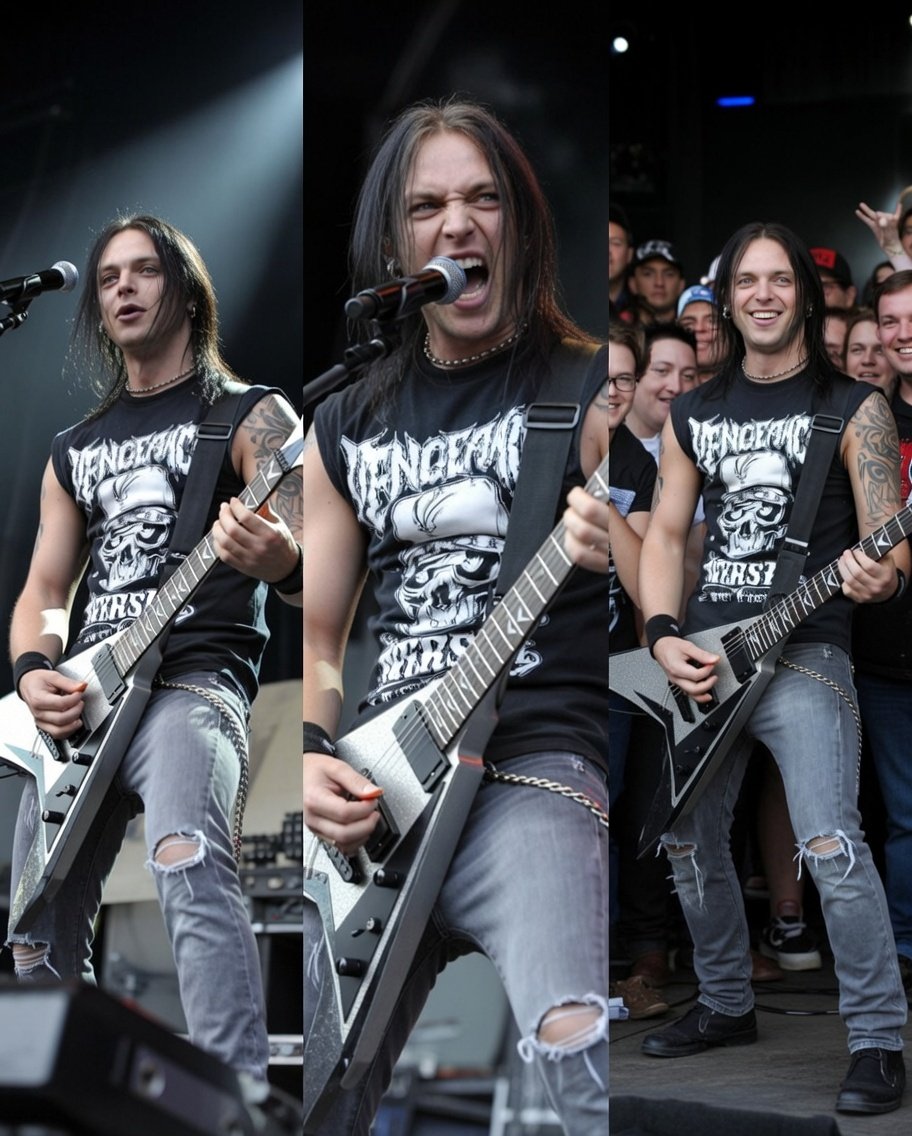
Matthew Tuck has never been just another frontman in heavy music. As the lead singer, rhythm guitarist, and primary songwriter of Bullet for My Valentine, he helped shape an entire generation of modern metal — blending razor-sharp riffs, melodic hooks, and emotional honesty at a time when the genre was rapidly evolving. But behind the aggression, precision, and arena-sized choruses lies a story defined not by overnight success, but by resilience, reinvention, and a fight to keep his own voice alive.
Born in Bridgend, Wales, in 1980, Tuck’s musical path was never guaranteed. Raised on a mix of classic metal and punk energy, he picked up the guitar young, drawn to the raw power of bands like Metallica, Slayer, and Megadeth. Early on, it was clear he wasn’t interested in fitting neatly into any scene — he wanted heaviness with purpose, melody with teeth. That vision would eventually become Bullet for My Valentine.
When the band broke through in the mid-2000s with The Poison, Tuck became an unlikely spokesperson for a new wave of metal. The album’s emotional intensity — heartbreak, anger, regret, and defiance — resonated deeply with fans who felt unheard elsewhere. Songs like “Tears Don’t Fall” and “All These Things I Hate” weren’t just aggressive; they were vulnerable. For Tuck, that honesty wasn’t a strategy — it was survival.
What many fans didn’t see was the toll that constant touring, vocal strain, and pressure took on him. By the early 2010s, Tuck began experiencing serious vocal issues. At one point, doctors warned him that continuing without proper treatment could permanently damage his voice. For a singer whose identity was inseparable from his sound, the possibility of losing it was devastating.
In 2014, Tuck underwent vocal surgery and was forced to relearn how to sing — essentially rebuilding his instrument from the ground up. The process was slow, humbling, and mentally exhausting. He later admitted that the experience changed how he viewed his career entirely. No longer chasing volume or aggression for its own sake, he began focusing on control, longevity, and intention.
That shift didn’t soften Bullet for My Valentine — it sharpened them. Albums that followed showed a band more confident in its power, less concerned with trends, and more committed to precision and weight. Tuck’s songwriting matured too, leaning into themes of perseverance, self-doubt, and inner conflict rather than youthful rage alone.
Outside of music, Tuck is notably private. He’s spoken about stepping back from the chaos of constant exposure, choosing family life and personal balance over nonstop visibility. That distance has only added to his mystique — a frontman who lets the music speak rather than feeding the spotlight.
Perhaps what makes Matthew Tuck most compelling isn’t his technical skill or his catalog of heavy anthems, but his refusal to quit when quitting would have been understandable. He didn’t just survive the pressures of success; he adapted to them. He didn’t just keep his voice — he learned how to protect it.
Today, Tuck stands as one of modern metal’s most enduring figures — not because he chased relevance, but because he stayed true to the core of what made his music matter in the first place. Loud when it needs to be. Honest when it hurts. And relentless in the face of silence.