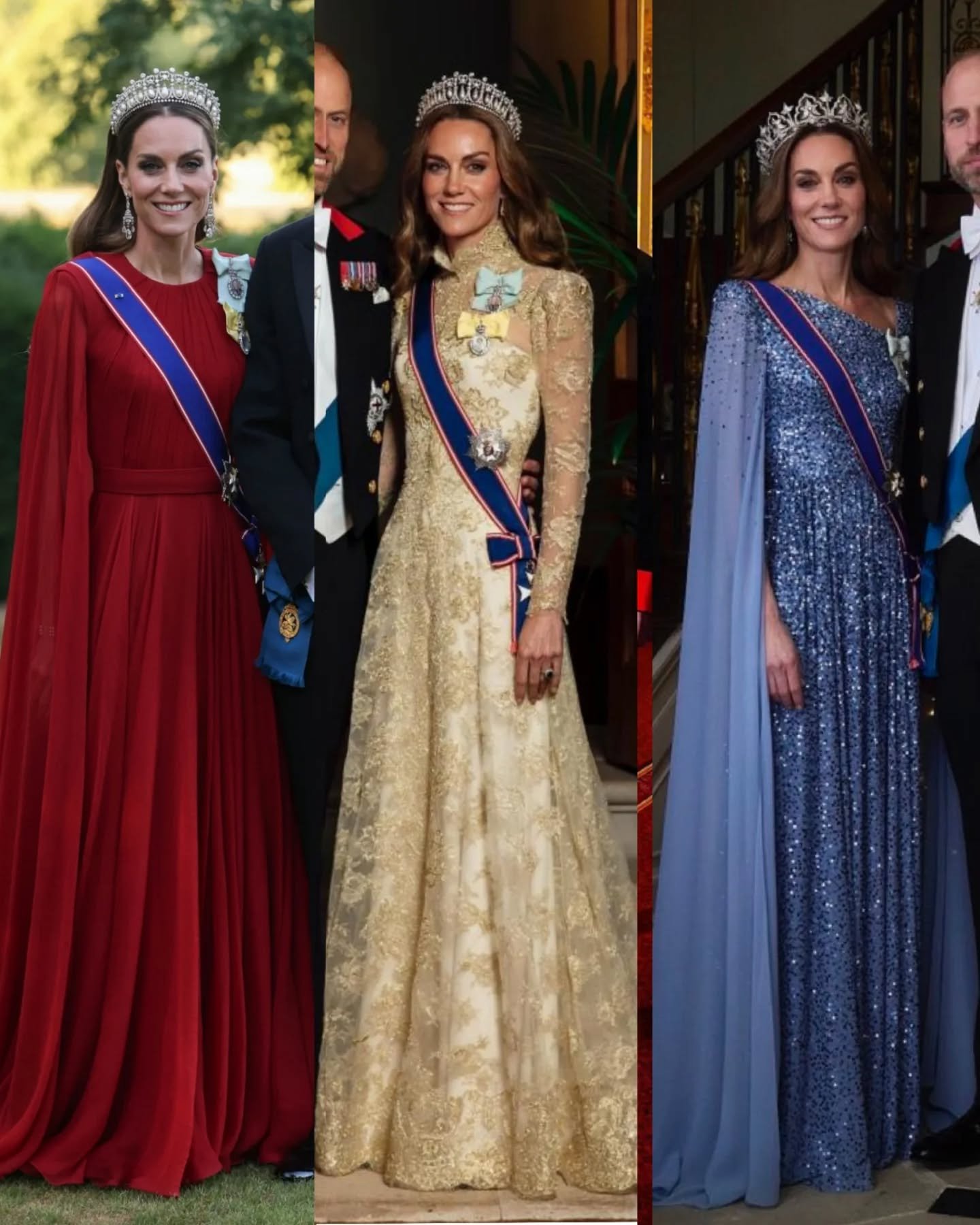
WINDSOR CASTLE, UK — At the recent State Banquet held in honour of the German President, Frank-Walter Steinmeier, and First Lady Elke Büdenbender, the sheer spectacle of diamonds and history was undeniable. However, amidst the splendour of the Queen Consort’s Girls of Great Britain Tiara and the Princess Royal’s aquamarine sparkle, one element of pageantry commanded particular attention: the headpiece worn by Catherine, the Princess of Wales.
The Princess made her spectacular debut in Queen Victoria’s Oriental Circlet Tiara, a magnificent masterpiece of diamonds and Burmese rubies. Yet, beyond the awe inspired by its historical heft and striking design, the fashion press and jewellery enthusiasts were united by a single, burning question: How on earth did she secure that enormous tiara, especially with her hair styled down?
The truth lies not just in the weight of the diamonds, but in the discreet, high-precision engineering performed by the royal hairdressing team. Securing a tiara of this magnitude is a secret blend of architecture, balance, and pure technical mastery, making the Princess’s choice a subtle yet powerful declaration of confidence.
I. The Colossal Scale of the Oriental Circlet
To understand the challenge, one must first appreciate the scale of the Oriental Circlet Tiara. It is, unequivocally, the largest and arguably the most visually imposing tiara Catherine has worn to date.
Commissioned by Prince Albert for Queen Victoria in 1853, the tiara is a tour de force of Victorian craftsmanship, incorporating 2,600 diamonds and featuring a distinctive ‘Mughal’ arch design. While originally set with opals, its current, more dramatic iteration features 17 vibrant Burmese rubies, giving it a stunning contrast against the diamonds.
Compared to the tiaras previously favoured by the Princess—such as the delicate and lighter Cartier Halo Tiara (worn for her wedding) or even the much-loved, though still significant, Lover’s Knot Tiara—the Oriental Circlet is massive. It is taller, wider, and possesses a much greater mass of metal and jewels. This weight distribution means it requires a far more robust anchor than its predecessors.

II. The Hairdressing Conundrum: Down-Do Versus Tiara
In the world of royal hairdressing, the golden rule for wearing a tiara is simple: structure is salvation.
Historically, tiaras are secured into tightly coiffed, structured updos—buns, chignons, or braids—which provide a solid base for the jewel to be threaded, pinned, and stitched into. The hair provides the scaffolding. When the hair is worn up, the tiara’s weight is distributed and its frame can be locked into place using specialized hat pins, which are virtually invisible against the dense fabric of the updo.
However, for the State Banquet, Catherine opted for her signature style: long, dark locks styled in soft waves flowing down her back. Wearing hair down while sporting a colossal tiara presents several critical issues:
- Lack of Friction: Loose hair is silky and allows metal to slip easily, especially when tilting the head or moving quickly.
- Insufficient Anchor Points: There are no tight points of structure to pin the tiara’s heavy base into.
- Visual Break: If the tiara were simply resting on loose hair, the transition between the scalp and the hair would look awkward, and the tiara would appear to float precariously.
The key to the Princess of Wales’s successful execution lies in her ability to marry the grandeur of a tiara with the modern softness of her preferred hairstyle.
III. The Hidden Architecture: The Tiara Shelf
Upon closer inspection of the photographs from the State Banquet, particularly the rear view of the Princess’s head, the secret is revealed. What appears to be a cascade of flowing hair is, in fact, an illusion of loose waves built around a formidable, hidden structure.
Royal hairdressers utilize an ingenious technique, sometimes referred to as a “tiara shelf” or a “tiara pad.” This involves isolating a section of hair at the crown—the precise area where the tiara will rest—and transforming it into a secure, dense anchor.
As keen observers noted, the back section of Catherine’s hair was meticulously “tied and twisted to anchor the tiara perfectly.” This process includes several meticulous steps:
- Creation of the Pad: A section of hair is pulled taut, twisted tightly, and then coiled into a compact, flat shape, resembling a small, horizontal figure-eight or a shallow bun. This structure is then heavily pinned with normal hairpins to the scalp to create a dense, immovable foundation.
- Reinforcement: To add grip and volume without bulk, the hairdresser often incorporates additional hairpieces (sometimes called “rats”) or highly texturized padding beneath or around the main coiled section. This provides material for the tiara’s band to “bite” into.
- The Stitching: This is the crucial, invisible step. The metal frame of the Oriental Circlet is not merely pinned; it is often sewn directly into the tiara pad using fine, durable thread that matches the Princess’s hair colour. The pins are used for initial positioning and stability, but the thread provides the ultimate, non-negotiable security, ensuring the tiara does not shift, even slightly, during an evening of bows, curtsies, and dining.
The remaining bulk of her hair is then carefully styled, curled, and draped over this tightly secured anchoring structure. From the front and side, the hair appears soft and flowing, completely concealing the intricate, heavy-duty scaffolding beneath.

IV. The Royal Hairdressers: Masters of the Invisible
This level of detail underscores the immense skill and discretion of the Princess of Wales’s long-serving hairdresser, who must be part stylist, part structural engineer. Their job is not merely to make the hair look beautiful, but to ensure that priceless, multi-million-pound heritage jewels are worn safely, comfortably, and, crucially, look effortlessly natural.
The hairdresser must calculate the tiara’s specific geometry, balance, and centre of gravity, and then construct a bespoke hair structure to counteract those forces. The Oriental Circlet, with its high arches, demands a stable, slightly forward-tilted position to maximize its visual impact, a tilt that is only possible with a solid rear anchor.
V. The Symbolism of Security and Size
Catherine’s assured deployment of the Oriental Circlet is more than a triumph of hairdressing; it is a profound visual metaphor for her place within the monarchy. The decision to wear her largest tiara yet, with a complex and challenging hairstyle, speaks volumes about her confidence in her role as Princess of Wales and future Queen Consort.
Having debuted the tiara successfully, she has added it to her rotation, signaling that she is ready and willing to embrace the heaviest, most historically significant pieces in the royal collection. This commitment to carrying the weight of the Crown’s most storied jewels—both literally and figuratively—reaffirms her status as a central pillar of King Charles III’s reign, ready to shoulder the responsibilities and traditions of the Monarchy with a blend of meticulous technical preparation and effortless grace. The hidden architecture of her hairstyle perfectly reflects the solid, yet discreet, foundation she provides to the future of the British Royal Family.