On August 16, 1977, the world was told that Elvis Presley was dead.
But almost immediately, a quieter story began circulating beneath the headlines — one that never truly went away.
What if Elvis didn’t die?
What if he walked away?
Nearly five decades later, a persistent theory still grips parts of American culture: that Elvis staged his death to escape fame, addiction, and the machinery that had owned him since he was a teenager.
No proof. No confirmation.
Just unanswered questions — and an ending that never quite felt finished.
A star who knew too much about control
By the mid-1970s, Elvis was no longer just a performer. He was a national asset, a global brand, and a man under constant scrutiny.
He had:
-
Been monitored by federal agencies
-
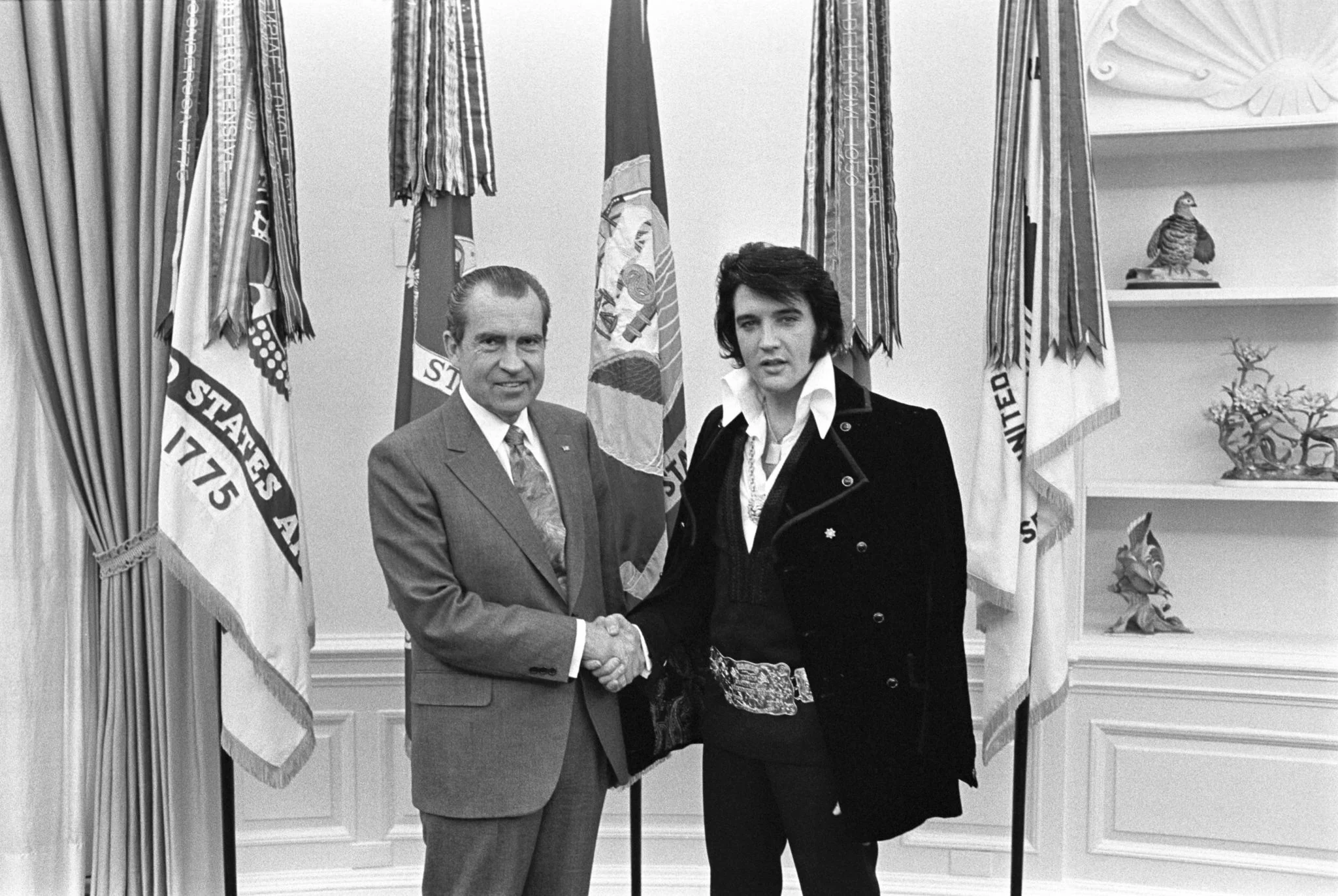
Met privately with President Nixon
-
Publicly aligned himself with authority
-
Privately spiralled under medication and pressure
According to the theory, Elvis understood something few celebrities do: you don’t quit fame — fame quits you.
Unless you disappear.
The White House meeting that fuels suspicion
In 1970, Elvis met President Nixon and requested a federal narcotics badge — a bizarre moment preserved in official archives.
Conspiracy theorists argue this wasn’t symbolism.
They claim:
-
Elvis feared being used as propaganda
-
He believed he was under surveillance
-
He wanted protection — or leverage
In this version of events, Elvis wasn’t aligning with power.
He was negotiating an exit.
A death that felt rushed
Elvis’ death shocked the world — but details surrounding it immediately raised eyebrows among sceptics.
They point to:
-
A rushed autopsy
-
No public release of certain medical materials
-
Conflicting accounts from witnesses
-
Heavy sedation that blurred timelines
To believers, it wasn’t sloppy.
It was intentional.
A quiet ending for a man who could no longer live loudly.
The Graceland funeral — closure or performance?
Thousands lined the streets of Memphis. Cameras rolled. The world watched the King laid to rest.
And yet, conspiracy forums obsess over details:
-
Limited viewing access
-
Reports of the body looking “unlike Elvis”
-
Closed casket decisions
The theory claims Graceland became the final stage set — not the final destination.
The sightings that never stopped
From the late 1970s through the 1990s, alleged Elvis sightings appeared across the US and overseas.
Gas stations. Airports. Small towns. Europe. South America.
Each story was dismissed.
Each one added fuel.
Believers argue not that Elvis wanted to be seen — but that people wanted him to be alive.
A legend that big couldn’t just end in a bathroom.
Why the theory survives
This story isn’t really about Elvis.
It’s about what America does to its icons.
Elvis represented:
-
Youth
-
Rebellion
-
Desire
-
Control
-
Consumption
And when his body failed, the idea that he simply died felt… unsatisfying.
The disappearance theory offers something else:
-
Agency
-
Choice
-
Escape
A man who refused to be consumed to death by his own myth.
Final thought
There is no evidence Elvis staged his death.
There never was.
But myths don’t survive on evidence.
They survive because they feel truer than the official ending.
And maybe that’s the real reason this story refuses to die.
Because part of America wants to believe that the King didn’t collapse under the weight of fame.
He slipped out the back door.
Quietly.