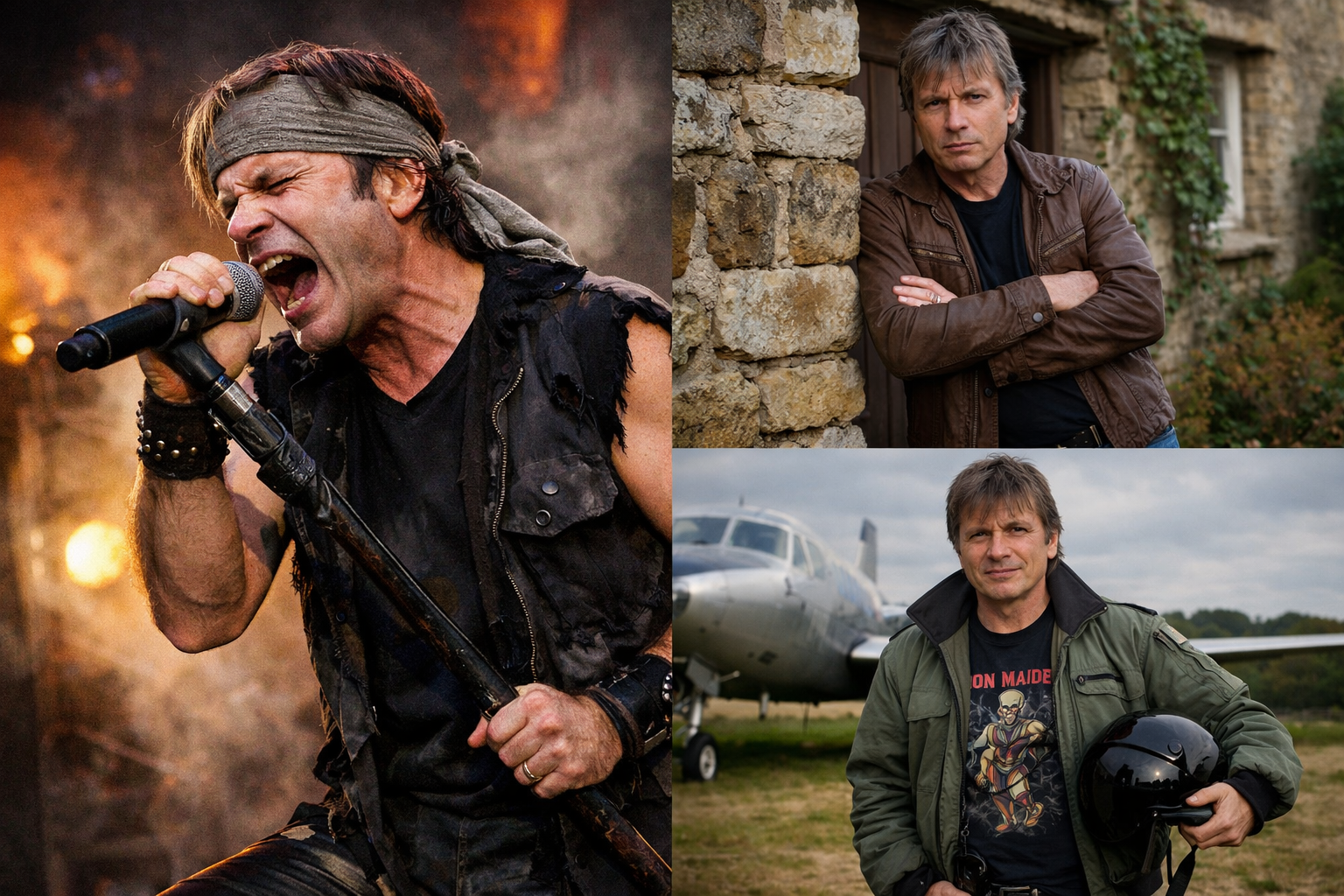
In the triptych before us, three versions of the same man exist at once—each real, each symbolic, each necessary. Together they tell a story larger than music, larger than fame. This is not a documentary portrait. It is a legend told through images, a fictional myth inspired by the idea of Bruce Dickinson as something more than human.
I. The Voice That Commands the Fire
In the first frame, he is all flame and motion. Veins rise like battle scars across his neck as he sings, mouth open wide enough to swallow the noise of the world. This is not just performance—it is confrontation. The microphone becomes a weapon, the stage a battlefield. The fire behind him does not threaten him; it answers him.
This version of Bruce exists only when sound reaches its breaking point. His scream is not chaos—it is control. The crowd may think they are watching a man sing, but in truth they are witnessing a force being released, something ancient that understands rhythm as law and volume as truth. In this moment, he is untouchable, untiring, eternal.
II. The Guardian of Quiet Stones
The second frame shifts abruptly. The fire is gone. The noise is gone. He stands outside his home, arms crossed, leaning against old stone walls that have survived centuries of wind and rain. His expression is calm, observant, almost guarded. This is a man who has learned the value of silence.
Here, the myth changes shape. This Bruce is the keeper of balance—the one who knows that power must rest or it will consume itself. The stones behind him do not cheer or scream. They endure. And so does he. This is where the voice goes to recover, where thunder learns patience.
It is easy to forget that legends need shelter. This image reminds us that even the loudest spirits require grounding, a place where no one demands a scream.
III. The One Who Walks Away
In the third frame, he stands in open space, holding a pilot’s helmet beside a small aircraft. The stage is far away now. The house is behind him. Ahead lies distance. Motion. Escape.
This is the most dangerous version of all—not because of volume, but because of freedom. This Bruce does not belong to crowds or walls or expectations. He belongs to the horizon. The aircraft behind him is more than a machine; it is a symbol of refusal—the refusal to be defined by one identity, one role, one myth.
He sings. He flies. He leaves.
And that is why the legend survives.
IV. Three Faces, One Myth
Together, the three images form a single story:
-
The Warrior of Sound
-
The Guardian of Silence
-
The Wanderer Beyond Both
This fictional Bruce Dickinson is not trapped by his own power. He moves between extremes, carrying the storm without letting it destroy him. The scream does not define him. The quiet does not erase him. The journey does not end him.
He is the proof that intensity and discipline can coexist—that fire can bow to control, and that legends are not born from noise alone, but from knowing when to step away from it.
In the end, this is not a story about a singer.
It is a story about mastery—of voice, of self, and of the space between thunder and silence.