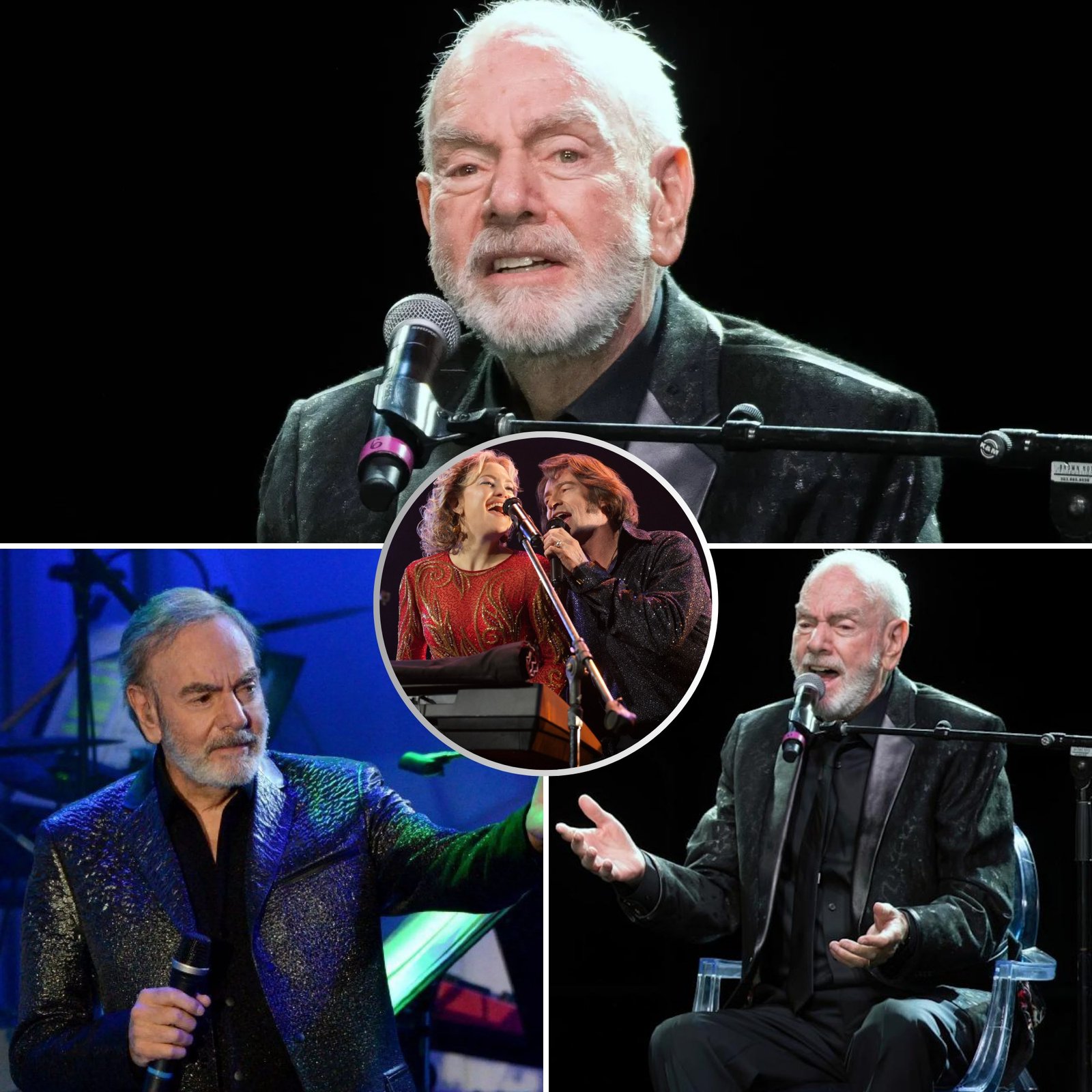
“I thought that chapter was closed — but music has a way of finding your heart again.”
Those words linger in the air long after Neil Diamond says them. They aren’t delivered dramatically. There’s no grand pause or sweeping music underneath. They come softly, almost as if he’s surprised by them himself.
The moment arrives as Song Sung Blue plays on a screen in front of him — familiar, yet strangely new. Not performed by him, not shaped by the voice the world has known for decades, but reborn through younger hands, younger voices, and a generation discovering its weight for the first time. What was once his now belongs to the world again.
And that realization hits harder than he expects.
A Chapter He Thought Was Finished
Neil Diamond had made peace with stepping away. The spotlight dimmed. The touring stopped. The noise quieted. Life narrowed into smaller, more private moments — days measured not by applause, but by endurance.
For years, he told himself that this was how stories were supposed to end: gently, respectfully, without interruption. He had given everything he had to music. Surely, it was allowed to rest.
But music, it turns out, doesn’t always respect endings.
The Unexpected Return
Watching Song Sung Blue resurface on screen isn’t just a professional experience — it’s personal. Each lyric opens a door he didn’t plan on reopening. Memories rush in uninvited: late nights writing alone, melodies born from uncertainty, songs shaped by love, doubt, and hope he barely understood at the time.
What surprises him most isn’t the nostalgia.
It’s the gratitude.
Neil doesn’t feel regret or longing for the past. Instead, he feels something quieter and heavier: the realization that his music outgrew him. That it lived on while he was learning how to live differently.
Battles Away From the Stage
Behind the scenes, lies a period the public never fully saw. Years marked by health challenges, personal recalibration, and moments when even listening to music felt too close, too raw. There were days when the distance from the stage felt like loss — and others when it felt like survival.
Music became something he carried rather than performed.
And yet, seeing it reborn like this — not polished for nostalgia, but embraced honestly by new voices — reshapes the meaning of what he once feared losing.
A Song That Refuses to Fade
As the performance unfolds on screen, Neil notices the audience’s reaction. Younger faces. Different lives. Same emotion. The words still land. The melody still holds. The song still knows where to go.
That’s when the tears come — not from sadness, but from relief.
Neil understands something deeply human: that art doesn’t belong to one season of life. It travels. It waits. It returns when you’re ready — or when you least expect it.
Healing in Unexpected Places
What could have been a simple tribute becomes something else entirely. A reminder. A quiet reassurance that even when parts of life feel closed off or unfinished, meaning continues to move beneath the surface.
Neil speaks about how success never guarantees peace, and how stepping away doesn’t always mean letting go. Some songs don’t fade because they were never meant to be temporary. They exist to outlast the person who created them — to become places others can rest.
The Power of Being Found Again
Neil Diamond doesn’t walk away from the moment changed overnight. There is no sudden return to the stage, no dramatic announcement. Instead, there is something subtler and more powerful: a renewed sense of connection.
To the music.
To the audience.
To himself.
The chapter he thought was closed wasn’t erased — it simply evolved.
And as the screen fades to black, one truth remains quietly undeniable: even in life’s hardest seasons, music has a way of finding what feels broken — and reminding it how to sing again.